
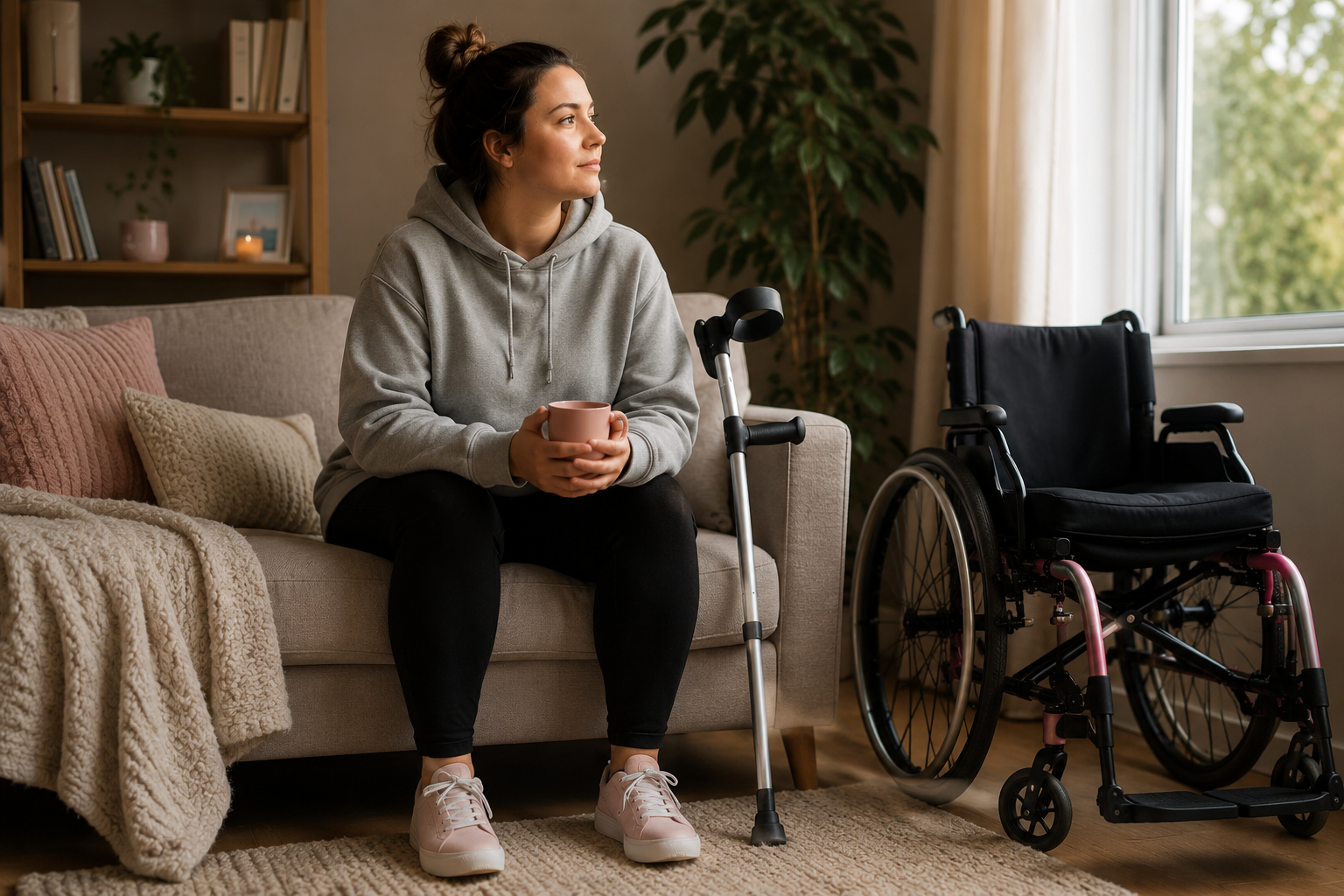
Quick answer: FND symptoms fluctuate, so many people can walk unaided on some days and need a stick, crutches, rollator or wheelchair on others. Using an aid only some of the time is not a contradiction and not "faking". People who can walk a little but still use a wheelchair are often called ambulatory or part-time wheelchair users. The aim is to save energy, stay safe and take part in more of life, not to prove how disabled you are on any given day.
One of the most painful things many people with FND hear is some version of: "But you walked yesterday." It can come from a relative, a colleague, a stranger in a car park, or the quiet voice in your own head. The message underneath is the same: if you could do it before, you should be able to do it now, and if you can't, something does not add up.
With FND, it adds up perfectly. Ability that changes from day to day, or hour to hour, is one of the most ordinary features of the condition. This guide is about using mobility aids on a part-time, as-needed basis without guilt, and about handling the reactions that fluctuating mobility tends to attract.
Why mobility can change day to day with FND
FND is a problem with how the nervous system sends, receives and coordinates signals, rather than damage to the nerves or muscles themselves. The "hardware" of the legs may be intact, but the "software" that runs movement can become unreliable. That is why the same legs can carry you to the shops one morning and feel weak, heavy, stiff, unsteady or stuck a few hours later.
NHS Inform describes how FND can affect movement, balance and walking, alongside fatigue, pain, sensory and cognitive symptoms. Neurosymptoms explains that functional symptoms are genuinely outside a person's control and can vary a great deal. That variability is the point: it is not evidence that the difficulty is imagined.
Lots of things can lower your capacity to walk safely on a given day, including:
- Fatigue and recovery debt after doing more than your nervous system could comfortably repay — see our FND symptom hangover guide.
- Functional seizures, tremor, dystonia or weakness that come and go.
- Sensory overload, stress, pain, heat or poor sleep, which all reduce how much the system can manage.
- How far and how long you need to go — a few steps at home is very different from a busy supermarket or a hospital corridor.
"But you walked yesterday" — and why it stings
When someone points out that you walked yesterday, it can feel like an accusation: that you are exaggerating, inconsistent or choosing the easy option. Even when it is meant kindly, it lands on a fear many people with FND already carry — the fear of not being believed.
It helps to separate two things. The first is the simple fact: yes, mobility varies, and that is expected with FND. The second is the feeling it triggers: the worry that using an aid makes your difficulty look less real. The fact is on your side. Aids are a response to a fluctuating condition, not proof that the condition is not there.
Walking is not pass or fail
"Can you walk?" is rarely a yes-or-no question with FND. A more useful question is: how far, for how long, how safely, and at what cost later? An aid can change every one of those answers for the better.
Aids are tools, not defeat
Many people resist a stick or wheelchair because it feels like "giving in", or like admitting the condition has won. It can help to flip that around. A mobility aid is not the moment FND defeated you; it is one of the tools that lets you keep doing things FND would otherwise take away.
A wheelchair used for the long museum visit can mean you actually see the exhibition instead of sitting exhausted in the café. A stick on an unsteady day can be the difference between going out and staying home. Crutches with a built-in seat can turn a queue from impossible into manageable. The aim is to spend your limited energy on what matters, which is exactly the principle behind pacing not racing.
Worry about "losing the ability to walk" is common, and worth discussing with your physiotherapist or occupational therapist. Using a wheelchair to cover distance or avoid falls does not, on its own, switch walking off — and for many people, saving energy with an aid is precisely what protects their walking for the times they need it most. The goal is to combine aids and movement in a way that fits your rehabilitation, not to choose one and abandon the other.
Choosing the right aid for the day
There is no single "FND aid". Most people who use them end up with more than one option and switch depending on how they feel, how far they are going and what they will be doing. A rough guide:
- Walking stick: light, portable and good for balance, confidence and a little support on steadier days. A folding stick can live in a bag for "just in case".
- Crutches or a walking frame: more support and weight relief when legs are weaker or less reliable.
- Rollator (wheeled frame with a seat): support plus somewhere to sit the moment you need it, which suits stop-start days and fatigue.
- Wheelchair (manual or powered): protects energy over longer distances and removes the pressure to keep going when standing or walking is not safe. Being pushed, self-propelling or using a power chair are all valid.
- Mobility scooter: useful for longer outdoor trips, shopping and keeping up with others without burning a whole day's capacity.
An occupational therapist or physiotherapist can help you choose the right aid, set it up at the correct height and use it safely — Neurosymptoms highlights occupational therapy as a key part of managing daily activities with FND. If you are waiting for an assessment, it is reasonable to trial an inexpensive aid in the meantime, but professional advice helps avoid habits that cause pain or falls.
Using a wheelchair part-time without guilt
Starting to use a wheelchair, especially when you can still walk, can bring a wave of complicated feelings: relief, grief, embarrassment and the fear of judgement all at once. A few things tend to make it easier.
- Start with one specific situation. "I'll use the chair for the shopping trip" is easier than "I am now a wheelchair user". You can keep it to high-cost activities at first.
- Expect mixed feelings. Feeling sad about needing an aid and grateful for what it gives you can both be true. The grief is real and it usually softens.
- Judge it by the result. If you got there, did the thing and had more left over afterwards, the aid did its job — regardless of how you felt walking in.
- You do not have to look consistent. Standing up from a wheelchair to reach a shelf, or walking the last few steps, is normal for part-time users. You are allowed to use exactly as much help as you need.
Handling other people's reactions
Fluctuating mobility attracts comments, questions and sometimes stares. You do not owe anyone your medical history, and you get to decide how much to explain. Short, calm lines tend to work best, and you can reuse them:
"My condition changes day to day. Yesterday I could walk; today I can't safely, so I'm using my chair. It's a normal part of FND."
"I can walk a bit, but not far or for long without it costing me. The aid is what lets me be here at all."
With strangers, you are allowed to say nothing, or simply "it's a medical thing" and move on. With people who matter, it is often worth explaining once, properly, that variable ability is part of the condition — so you are not re-justifying yourself every time. If self-doubt is the harder voice, our piece on the "am I faking it?" spiral and the good-day problem may help.
For friends, family and colleagues
The most supportive response to changing mobility is not to keep score. "What would help today?" is worth more than "but you managed last week". Believe the person in front of you, on the day you are with them.
Practical and financial support
FND is assessed on how your symptoms affect you, not on the diagnosis label, so fluctuating mobility can count towards support even if you are not affected every day. When you apply for anything, describe your worst and most variable days honestly, including how often they happen and how unpredictable they are.
- Blue Badge: you can apply for a Blue Badge based on the impact of your condition, including hidden and fluctuating difficulties.
- PIP / Adult Disability Payment: the mobility component can apply when walking is limited or unreliable. Our FND and PIP guide covers evidence, the mobility rules and routes to Motability.
- Equipment: aids may be available through the NHS, an occupational therapy assessment, local social care or disability charities — ask your GP or specialist team how to be referred.
- Out and about: you have rights as a disabled passenger on public transport, including help getting on and off with an aid.
Track what helps, not just what hurts
Because mobility varies, it can be hard to see the pattern from inside it. Tracking turns "I never know how I'll be" into something you can plan around — and gives you clear, concrete examples for assessments and appointments.
SeizeControl can help you keep mobility alongside the things that affect it: activity, distance, fatigue, functional seizures, pain, sleep, heat and how long recovery took. Useful things to record include:
- Which aid you used, for what, and whether it helped you do more or recover faster.
- The days walking was unreliable, and what had happened before them.
- How far you could go comfortably, and at what cost the next day.
- What made a difference: resting first, a seat to break the journey, or choosing the chair early.
Make fluctuating mobility visible
Use SeizeControl to track mobility and its triggers
A structured record can show whether walking gets harder after poor sleep, heat, busy days or stacked commitments — useful for pacing and for evidence.
Open SeizeControl.ukPlan the day around your capacity
Decide when an aid will protect your energy
SeizeControl's Energy Planner turns the risk forecast into six-hour energy windows, so you can see when taking the chair or stick will help you do more and crash less.
Open the Energy PlannerFrequently asked questions
Is it okay to use a wheelchair or walking stick only some of the time with FND?
Yes. FND symptoms often fluctuate, so many people walk unaided on some days and need a stick, crutches, rollator or wheelchair on others, or even within the same day. Using an aid when you need it is a practical decision, not a contradiction. People who can walk a little but still use a wheelchair are sometimes called ambulatory or part-time wheelchair users, and this is common and valid.
Why can I walk one day and not the next with FND?
In FND the nervous system has trouble sending and receiving movement signals reliably, so the same legs can work well one moment and feel weak, heavy, unsteady or stuck the next. Fatigue, pain, stress, sensory overload, poor sleep, heat, functional seizures and simply doing too much the day before can all lower your capacity. The variability is part of the condition, not a sign that the difficulty is not real.
Will using a wheelchair make my FND worse or make me lose the ability to walk?
Using a wheelchair to save energy, avoid falls or extend how far you can go does not, by itself, cause the ability to walk to disappear. Many people use a wheelchair part-time precisely so they can keep walking on the days and for the tasks that matter most. If you have a rehabilitation plan, ask your physiotherapist or occupational therapist how to combine aids with movement so they support your goals rather than work against them.
How do I respond when people say "but you walked yesterday"?
A short, calm explanation usually works best: "My condition changes day to day. Yesterday I could walk; today I can't safely, so I'm using my chair." You do not owe anyone a full medical history. With people who matter, it can help to explain once, clearly, that fluctuating ability is a normal part of FND and that the aid is what lets you take part at all.
Which mobility aid should I use with FND?
It depends on the day and the task. A walking stick can help with balance and confidence, crutches or a rollator give more support and a seat to rest on, and a wheelchair or mobility scooter protects energy over longer distances. Many people use more than one and switch depending on how they feel. An occupational therapist or physiotherapist can help you choose safely and set up the aid correctly.
Can I get help with the cost of mobility aids or a Blue Badge with FND?
Possibly. FND is assessed on how your symptoms affect you, not on the diagnosis label, so fluctuating mobility can count. You may be eligible for a Blue Badge, for Personal Independence Payment (or Adult Disability Payment in Scotland) which can lead to Motability, and sometimes for equipment through the NHS, social care or charities. Describe your worst and most variable days honestly when you apply.
Sources and further reading
- NHS Inform: Functional neurological disorder
- Neurosymptoms: Functional neurological symptoms (Prof Jon Stone)
- Neurosymptoms: Occupational therapy
- FND Action: What is functional neurological disorder?
- GOV.UK: Apply for a Blue Badge
- GOV.UK: PIP eligibility
- FND Connect: FND and PIP benefits
- FND Connect: Pacing Guide - Pacing Not Racing With FND
- FND Connect: SeizeControl seizure tracking app