
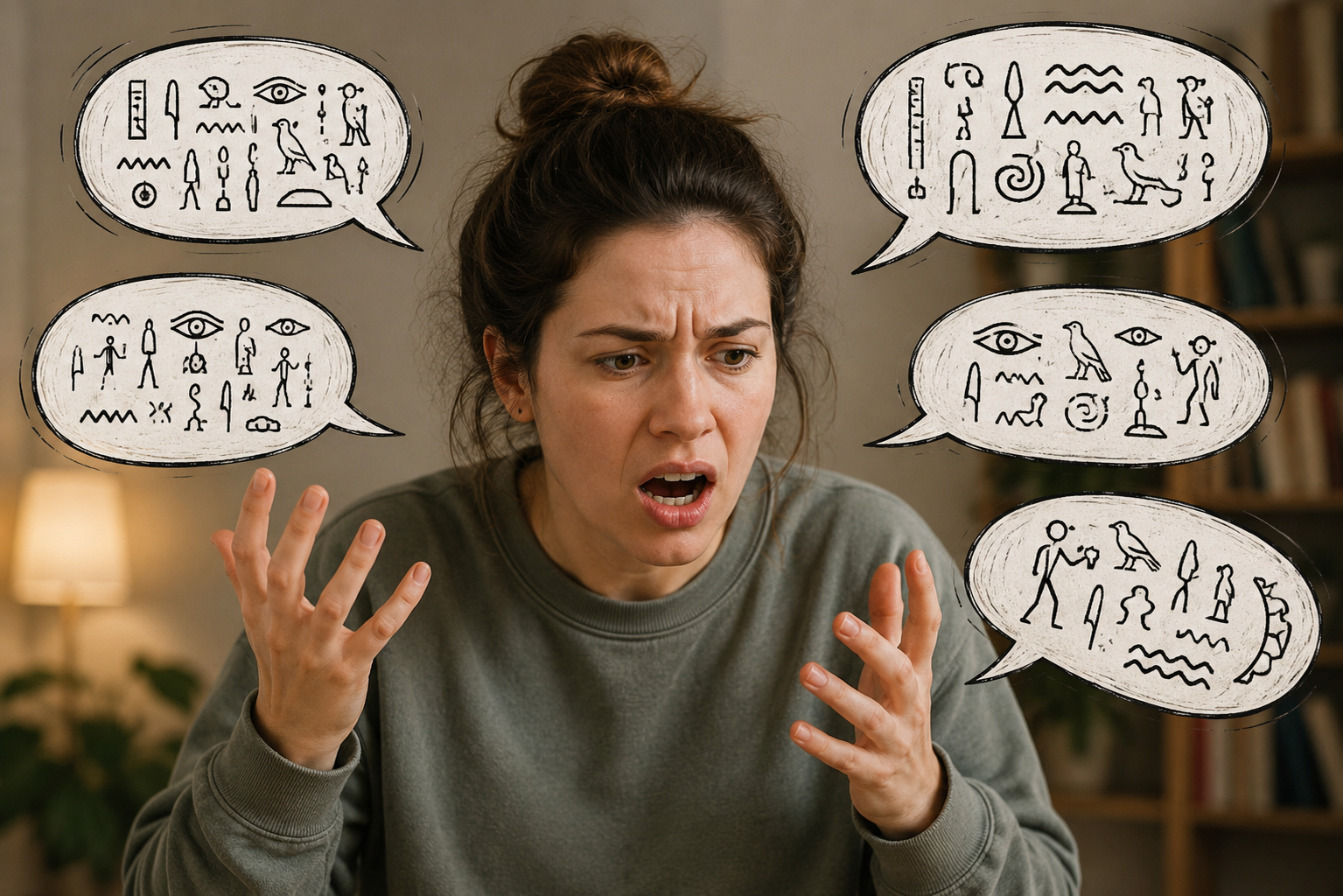
Quick answer: speech changes can happen as part of FND. Some people stutter, slur, lose words, speak in short broken phrases, go completely silent, sound like they have a different accent, or produce speech that sounds fluent but does not make recognisable sense. It is not the person putting it on. It is a problem with how the brain is accessing and controlling speech at that moment.
You know what you want to say.
That is the bit people often miss.
The answer is there. You can hear the question. You understand what is being said. You may even be silently screaming the reply inside your head.
But when you try to speak, something else happens.
Nothing comes out. Or the words come out in the wrong order. Or only the important words survive. Or you suddenly stutter. Or your voice changes. Or you start speaking what your family now refers to as “that episode language”, because nobody has any idea what you are saying, including you afterwards.
If this has happened to you, you are not alone. Speech changes during FND episodes are much more common than people realise. They can be scary, embarrassing, exhausting and strangely funny, often all in the same day.
The different ways speech can change
FND speech symptoms do not look the same for everyone. They can also change from episode to episode. Some people have one very familiar pattern. Others get the full variety pack.
Broken, stripped-back speech
This is where speech comes out in fragments.
You might mean to say, “I need to sit down because my legs are starting to go and I feel an episode coming.”
What actually comes out is:
“Need... sit... legs... bad.”
It can sound blunt or odd to people listening, but from the inside it can feel like your brain has removed every non-essential word just to get the message out.
A stutter that appears from nowhere
Some people develop a stutter or stammer during episodes, even if they do not usually stutter. It may come with effort, tension, repeated sounds, long pauses, or words getting stuck at the starting line.
This can be especially unsettling when people know your usual speech well. One minute you sound like yourself. The next, your speech has completely changed.
A different voice or accent
Some people notice their voice changes during episodes. It may become quieter, flatter, higher, slower, strained, childlike, or oddly unfamiliar.
Others experience an accent change. It can be subtle, or it can be so noticeable that people comment on it. This is not someone “putting on a voice”. Functional accent changes are recognised, and they can be deeply confusing for the person experiencing them.
Total silence
This one can feel brutal.
You are awake. You can understand. You may know exactly what you need. But the words do not come.
People sometimes assume silence means confusion, distress, refusal, or lack of awareness. That assumption can be very wrong. Many people with FND-related speech loss understand everything around them. They just cannot get speech to work at that moment.
Fluent nonsense
Then there is the one that comes up again and again in FND communities.
The strange episode language.
It is not just mumbling. It is not always random sounds. It can have rhythm, tone, emphasis and flow. It can sound like you are speaking a real language from somewhere, just not anywhere anyone can identify.
You may be answering a question. You may be annoyed that nobody understands you. You may repeat the same “phrase” for the same answer. Then later, when you are well, you cannot reproduce it at all.
That is one of the reasons it can feel so strange. If you try to fake it on a normal day, it usually falls apart within seconds. During an episode, it can pour out without effort.
If it sounds made up, does that mean I am making it up?
No. This worry is very common, but it is also deeply unfair on yourself. FND symptoms are not chosen. They happen because the brain is not controlling or accessing a function properly at that moment. Speech can sound odd, dramatic, inconsistent or impossible to explain. That does not make it fake.
If you often get stuck in the “am I faking it?” spiral, you may also find this useful: Am I faking it? The FND self-doubt spiral.
Why speech can be affected in FND
Speech feels simple because we do it all the time. It is not simple.
To say one sentence, your brain has to choose the words, arrange them, control breathing, move the tongue, lips and jaw, use the voice, monitor the sound, and adjust everything as you go.
Most of that happens automatically. You do not normally think about where your tongue needs to go to say a word. You just speak.
In FND, automatic control can stop working properly even though the structure of the nervous system is not damaged in the way it would be after a stroke or injury. A common explanation is that the “software” is not running properly, even though the “hardware” is intact.
That is why speech can go offline while understanding stays online.
It is also why some people can still swear, sing, laugh, cry, or say automatic phrases when normal speech is stuck. Those types of speech can use different, more automatic pathways. It can seem bizarre, but it is a known pattern in neurological speech symptoms.
Speech changes often appear when the whole system is overloaded. Common triggers include fatigue, pain, stress, sensory overload, heat, poor sleep, functional seizures, dissociation, brain fog, busy environments and emotional strain.
Important: sudden speech loss, slurred speech or a new speech change should always be taken seriously, especially if there is face drooping, arm weakness, confusion, severe headache, chest pain, collapse, or anything different from your usual pattern. If stroke is a possibility, call 999. Do not assume every new symptom is FND.
What it feels like from the inside
The hardest part is often not the speech itself. It is how people react.
Being spoken to like a child.
Being talked about while you are sitting right there.
People asking question after question when you cannot answer one.
Someone panicking when you need calm.
Someone telling you to “try harder”, when trying harder is exactly what makes the whole thing jam more.
Inside, you may feel completely present. You may be embarrassed. You may be angry. You may be trying so hard to get one word out that your whole body tenses.
That pressure rarely helps.
For many people, speech comes back more easily when the pressure drops. Less noise. Fewer questions. More time. A calmer room. A way to point, type, gesture, or use yes and no.
Speech usually returns as the episode settles. Sometimes quickly. Sometimes slowly. Sometimes with a tired, croaky, careful voice afterwards.
The funny side, when you are allowed to find it funny
There is a rule here.
The person having the episode gets to decide when it is funny.
Because sometimes it is. Not always. Not when it costs you something. Not when you are scared. Not when someone else laughs first.
But there are moments.
The partner who nods seriously through thirty seconds of fluent mystery language.
The dog who appears to understand you better than anyone else.
The family who know the difference between “slightly scrambled” and “full ancient prophecy mode”.
Humour can be a form of control. It says, “This happens to me, but it does not get to take every part of me seriously.”
And on the days when it is not funny at all, that is fine too.
What can help during an episode
- Have a note ready on your phone. Keep it simple. “I have FND. My speech is affected, but I can understand you. Please give me time. This usually passes.”
- Use yes and no signals. Agree them in advance. Thumbs up and down. One squeeze for yes, two for no. Blinking. Pointing. Whatever works for you.
- Try typing. Some people can type when they cannot speak. A notes app or text-to-speech app can make a huge difference.
- Use communication cards. Cards for water, quiet, pain, toilet, ambulance not needed, call my person, yes, no, and I need a minute.
- Reduce pressure. Fewer questions. More time. Less noise. Calm voices. No crowding.
- Do not force speech. Trying to push through can make it worse. Let your system settle first.
- Ask about speech and language therapy. Functional speech symptoms can be supported by speech and language therapists who understand FND.
For the person listening
If someone you care about has FND speech changes, the best thing you can do is stay calm and treat them like they are still there.
Because they are.
- Speak normally. Do not shout unless they have asked you to. Do not use a baby voice.
- Give time. Silence is not refusal. It may be effort.
- Use yes/no questions. Keep them short.
- Do not talk over them. Include them, even if someone else is helping.
- Do not ask them to perform the symptom later. Many people cannot reproduce it once the episode has passed.
- Learn their usual pattern. That helps you know what is normal for them and what needs urgent help.
- Let them lead the humour. Laugh with them, not at them.
Tracking speech changes
Speech changes can feel random, but they often have patterns.
They may happen more after poor sleep, pain, stress, heat, sensory overload, busy days, hormonal changes, functional seizures or fatigue crashes.
Writing it down helps. Not because you need to prove anything, but because patterns are easier to spot on paper than in the middle of an episode.
Spot the pattern behind the episodes
Track speech changes with SeizeControl
SeizeControl helps you log episodes, functional seizures, symptoms, sleep, triggers and recovery notes, so you can build a clearer picture of what affects your speech and take better information into appointments.
Open SeizeControl.ukFrequently asked questions
Why does my speech change during an FND episode?
Speech is a complex motor and communication task. During an FND episode, the brain can struggle to access or control speech automatically. This can lead to slurred speech, broken words, stuttering, silence, changed voice, changed accent, or speech that sounds like nonsense.
Can FND make me speak gibberish or a strange language?
Many people with FND describe speech that sounds fluent but does not make recognisable sense during episodes. It can be very distressing and confusing, but it is a recognised type of functional speech difficulty.
Why can I not reproduce it when I am well?
Because functional symptoms are not deliberate. They happen when the system is not working properly in that moment. Being unable to reproduce the speech later does not mean you were faking it.
Why can I understand people but not answer?
Understanding language and producing speech are not the same process. In FND, speech production can be disrupted while understanding stays intact.
Why can I still swear or sing when I cannot speak normally?
Swearing, singing and well-practised phrases can use more automatic speech pathways. These may still work when deliberate speech is stuck.
When should I get urgent medical help?
Call 999 if speech loss or slurring is sudden, new, or comes with stroke signs such as face drooping, arm weakness or confusion. Also seek medical advice if the symptom is different from your usual FND pattern.