
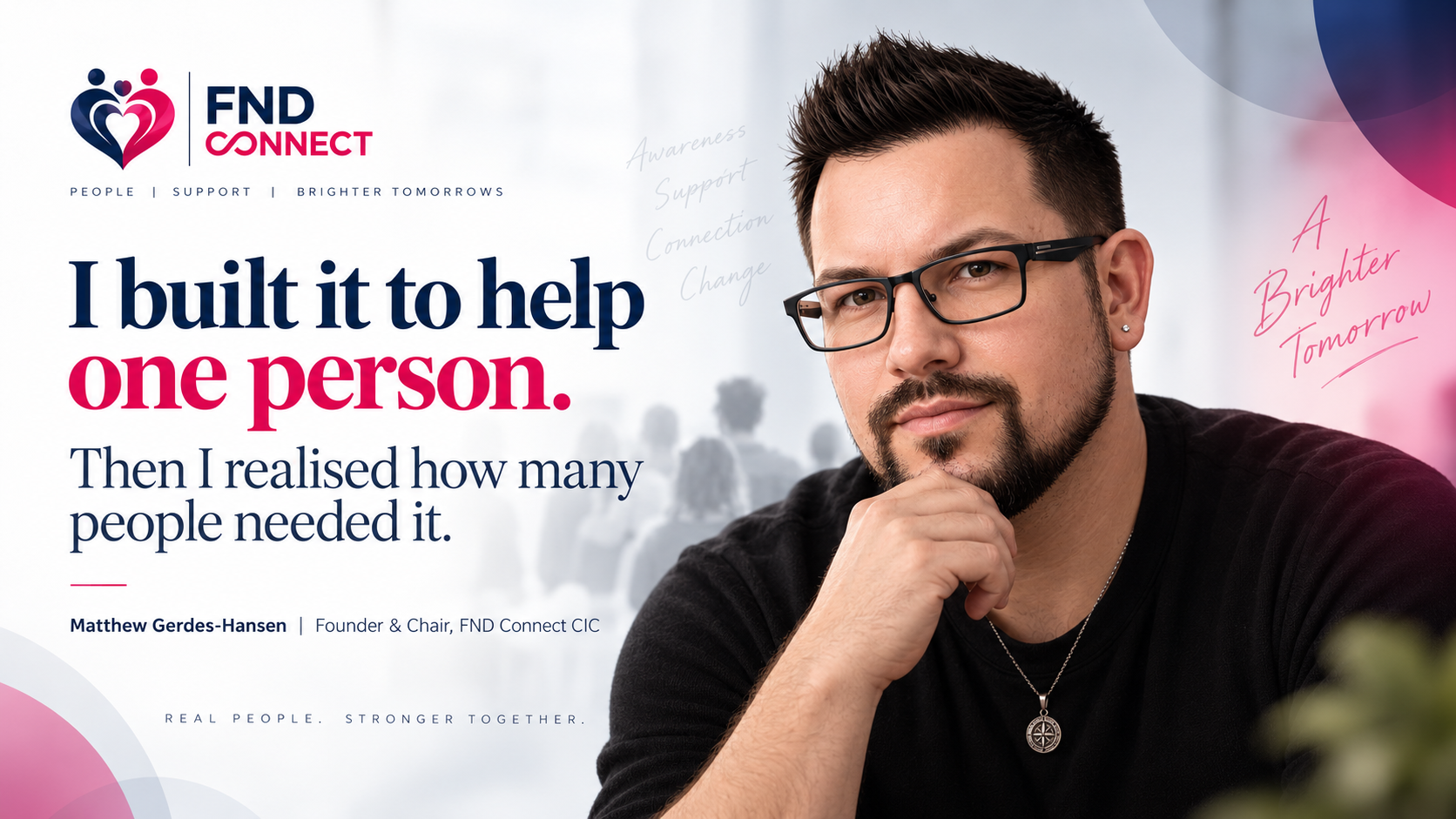
Three years ago, I had never heard of Functional Neurological Disorder.
I did not work in healthcare. I was not involved in a neurological charity. I did not have some grand plan to start a non-profit.
Then I met Emma.
Emma is now my wife, and FND is part of our everyday life.
As I learned more about the condition, I also started to see the gaps.
There was clinical information explaining what Functional Neurological Disorder was, but finding practical information about actually living with it was much harder.
What happens after the diagnosis?
How do you understand what triggers or worsens your symptoms?
How do you explain what is happening to your GP?
How do you spot patterns when your symptoms are unpredictable?
How do you manage life when one day can look completely different from the next?
And perhaps most importantly, where do you go when you need somebody who actually understands?
It started with a problem I wanted to solve for my wife
Emma's seizures were becoming increasingly difficult to manage.
I wanted to find a way of recording what was happening properly.
Not just a diary saying, "Emma had a seizure today", but something that could look at symptoms, timing, environmental factors and previous patterns and turn that information into something useful.
So I built one.
That eventually became SeizeControl.
It could record seizures and symptoms, identify patterns and create reports that could be shared with healthcare professionals.
At that point, I had a decision to make.
I could have packaged it up and sold it.
There was a commercial product there. I could probably have made money from it.
But every time I thought about doing that, I kept coming back to the same question.
If Emma needed this, how many other people with FND needed it too?
And how many of them would never use it if the first thing we did was put a price on it?
So I made it free.
That decision changed everything.
FND Connect grew from there
Once we started speaking to more people living with FND, it became obvious that the problem was much bigger than a piece of software.
People were being diagnosed and then feeling abandoned.
Families did not understand what was happening.
People were struggling to explain their symptoms to employers, doctors, friends and relatives.
Some had never spoken to another person with FND.
Others were trying to navigate an incredibly complicated condition while feeling as though they had been handed a diagnosis and then left to get on with it.
We could not solve all of that with an app.
So FND Connect began to grow.
We started developing practical information.
We built community support.
We began creating resources aimed at the reality of living with FND rather than simply defining the condition.
We developed online support and started building face-to-face support groups.
We began speaking to healthcare professionals, services and other organisations.
And what had started as something I built for Emma started becoming something much bigger.
The part of this journey I am most proud of
It is not the technology.
It is not the website.
It is not how quickly FND Connect has grown.
It is the community that has formed around it.
People supporting someone they have never met.
Someone joining a group frightened and uncertain, then coming back a few weeks later to reassure the next new person.
Volunteers giving their time because they know what it feels like to need somewhere like this.
People sharing their stories so that somebody newly diagnosed might feel slightly less alone.
That is what FND Connect is becoming.
Not simply an organisation that provides information.
A community built around the belief that nobody should have to navigate FND alone.
But growth creates another problem
FND Connect has grown extraordinarily quickly.
That tells us something positive about what we are building.
It also tells us something uncomfortable about how much unmet need exists.
More people are finding us.
More communities want local support.
There is more awareness work we could be doing.
There are more resources we want to develop.
There are more healthcare and community services we would like to work with.
But every new service costs something to provide.
Technology costs money.
Venues cost money.
Training costs money.
Printing resources costs money.
Insurance, infrastructure, systems and all the other unglamorous things required to run a responsible organisation cost money.
We made a deliberate decision that the support people receive from FND Connect should not depend on whether they can afford it.
I still believe that was the right decision.
But free support is not free to provide.
This is the next chapter
My job now is different from the one I had when I first sat down and started building SeizeControl.
I am still building.
But now I am building an organisation.
That means creating something sustainable enough to still be here years from now.
It means developing partnerships with businesses, healthcare professionals, funders, community organisations and people who believe in what we are trying to achieve.
It means finding organisations that are prepared to say:
"We believe people living with FND deserve better support, and we want to help make that happen."
FND Connect is still young.
There is a huge amount we want to do.
And there are undoubtedly things we will learn and improve along the way.
But I know why we started.
I know who we are building it for.
And I know the principle I do not want us to lose as we grow.
FND Connect started because one person I loved needed something that did not exist.
Instead of selling the solution to her problem, I chose to share it.
Today, we are building an organisation around that same idea.
If we can create something that genuinely helps people, we should find a way to get it to as many of them as possible.
If you work in healthcare, corporate social responsibility, grant funding, philanthropy, community services or you simply believe in what we are building, I would genuinely like to connect.
We have proved that there is a need.
Now we need to make sure we can keep meeting it.
Matthew Gerdes-Hansen
Founder & Chair
FND Connect CIC