
Home, mobility and independent living
FND Home Adaptations: OT Assessments and Disabled Facilities Grants
If stairs, bathing, cooking or getting through your own front door has become unsafe or unreliable, you can ask for a home assessment. FND can be relevant, but funding is based on the barrier and assessed need—not the diagnosis label alone.
The quick answer
Yes, someone with FND may be eligible for assessed equipment, home adaptations or a Disabled Facilities Grant—but FND does not automatically qualify anyone. The decision is about what you cannot do safely or reliably at home, whether an adaptation is necessary and appropriate, and whether the proposed work is reasonable for the property.
Start by asking the relevant council, social care or occupational therapy service for a home assessment. Do this before buying expensive equipment or starting building work. The funding name and process differ across the UK.
When the home becomes part of the problem
FND symptoms can vary. A staircase that is manageable on a steadier morning may become unsafe when weakness, tremor, dizziness, functional seizures, pain, fatigue or cognitive overload are worse. That variability does not make the barrier imaginary. It does mean the assessor needs a clear picture of the pattern rather than one snapshot.
A home assessment can consider small changes, equipment and larger structural work. The NHS home-adaptations guide gives examples including stairlifts, grab rails, walk-in showers, widened doorways, lowered worktops, ramps and door-entry systems. The right answer is not always the biggest alteration; it is the safest workable response to the assessed need.
If what you need is a wheelchair, walking aid or advice on using mobility equipment part-time, read our separate FND mobility-aids guide. This article is about the home, the assessment and adaptation funding.
Use the route for where you live
“Disabled Facilities Grant” is not one identical UK-wide process. Start in the right place and ask how your housing tenure affects the route.
England
Ask your local council for a home assessment and its Disabled Facilities Grant process. GOV.UK currently lists a maximum mandatory grant of £30,000, although some councils may offer more through local policies. Adult awards are means-tested.
Wales
Local authorities can use Disabled Facilities Grants and the Welsh Government’s ENABLE support routes. GOV.UK currently lists up to £36,000 for a DFG. Ask the council which scheme fits the scale and urgency of the work.
Scotland
Disabled Facilities Grants are not available. Contact the local council’s social work team for a care-needs assessment. Financial help and the contribution rules depend on the adaptation, tenure and local policy.
Northern Ireland
For an owner-occupier or private tenant, major work is normally considered through the Housing Executive after an HSC Trust occupational therapist recommends it. The current NIHE leaflet says grant aid may be up to £35,000, with discretion up to £70,000 for complex cases.
Amounts are ceilings, not promises. A means test, the assessed work, property feasibility and local arrangements can all affect what is offered. Disabled children under 18 can receive a DFG in England and Wales without their parents’ income being taken into account. GOV.UK also says a DFG does not affect benefits.
A script for requesting a home assessment
You do not need to diagnose the building or arrive with a shopping list. Start with the activity and the risk.
“I have Functional Neurological Disorder, which affects my [walking / balance / strength / awareness / fatigue]. I am struggling to [use the stairs / wash / reach the toilet / prepare food / enter and leave the home] safely and reliably. This happens [how often], and on worse days [what happens]. Please tell me how to request a home or occupational therapy assessment for equipment and adaptations, and which team manages major adaptations for my tenure.”
If phone calls are difficult, send the same wording through the council’s online form or email and keep a copy. Ask what happens next, likely waiting times, whether urgent risk changes priority, and who to contact if your circumstances change.
Prepare around tasks, not labels
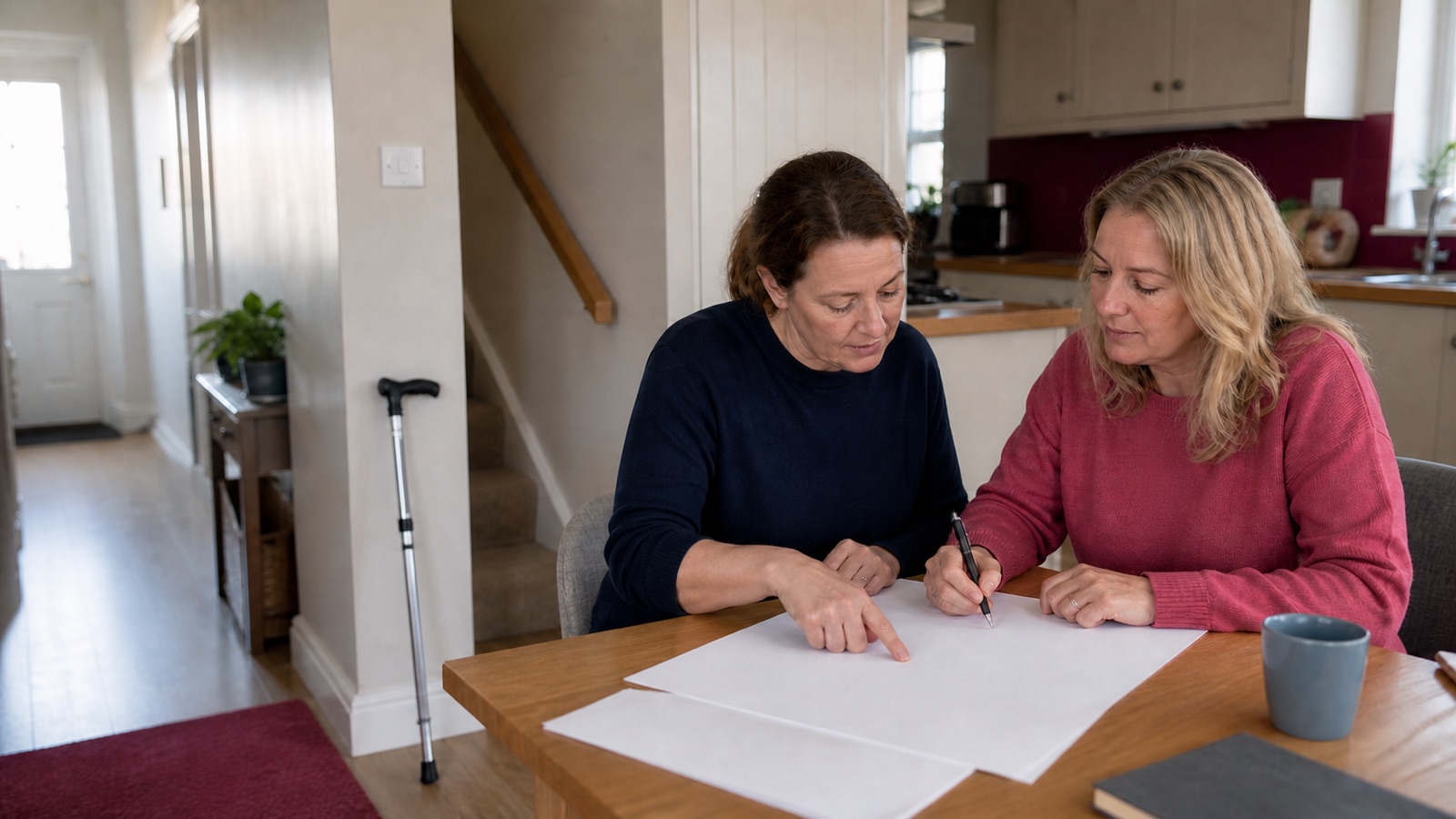
An assessor needs to understand the interaction between you, the task and the home. A short record is more useful than saying only “my FND is bad”. For each problem, describe:
- the room, route or task
- what goes wrong
- how often it happens
- whether you can do it safely
- how long it takes
- whether it can be repeated
- help, supervision or equipment used
- falls, near misses or injuries
- fatigue, pain or symptom after-effects
- what changes on a better day
Do not deliberately push until symptoms escalate to “prove” the problem. Explain what usually happens. If a carer changes their own routine to make the task possible—waiting outside the bathroom, carrying items on stairs, supporting transfers or staying nearby after an episode—include that too.
A simple seven-day home-barrier log
| Task | What happened | Help or risk | After-effect |
|---|---|---|---|
| Stairs after shower | Left leg became weak halfway up; stopped on step for four minutes. | Partner stood behind; near fall turning at the top. | Needed to lie down for 40 minutes. |
| Preparing lunch | Could not stand long enough to finish safely. | Used a dining chair beside the worktop; carried hot pan while unsteady. | Skipped the hot meal. |
| Front step | Managed going out in the morning; could not lift foot over the step on return. | Neighbour helped; walking stick alone was not enough. | Stayed indoors the following day. |
These are examples, not words to copy. Use your real pattern. Photos or video of the layout can help if safe and relevant, but do not film an episode or put yourself at risk for evidence.
What to ask during the assessment
- What need have you recorded, and can I have a copy of the assessment or recommendation?
- Are there smaller items we can trial before permanent work?
- How will this option work on both better and worse FND days?
- Could it create a new barrier—for example a rail that narrows a route or equipment that cannot be moved during a seizure?
- Who maintains, repairs and eventually removes the adaptation?
- Does the landlord need to consent, and who will ask?
- Is there a charge, means test or contribution? Which fees can the grant cover?
- What is the next decision point, expected timescale and contact person?
You can ask a relative, friend or advocate to attend. The NHS says a home assessment is free and notes that having someone with you can help with explaining the situation and taking notes.
The grant process in England and Wales
- Request an assessment. The council may use an occupational therapist or trained assessor to identify what changes are needed.
- Confirm the proposed work. The council must be satisfied it is necessary and appropriate for the disabled person and reasonable and practicable for the property.
- Complete the financial and property checks. Adult DFGs are normally means-tested. An owner, tenant or landlord can submit the application, subject to the scheme rules.
- Wait for written approval. GOV.UK says the council must give a decision within six months. Do not treat an assessment recommendation as grant approval.
- Only then arrange the work. GOV.UK warns that starting first may mean no grant. Planning permission or building-regulations approval may be separate.
- Finish and sign off. GOV.UK says approved work should normally be completed within 12 months. Agree inspections, invoices and payment arrangements before work starts.
If you rent or live in social housing
Do not assume “I rent” means “I cannot ask”. In England and Wales, the published eligibility route allows an owner, tenant or landlord to apply. The practical route can still differ:
- Council or housing-association tenant: contact the landlord’s adaptations or tenancy team and the local assessment service. The landlord may have its own programme rather than asking you to manage a DFG.
- Private tenant: ask the council how it coordinates assessment, grant and landlord permission. Get any consent in writing.
- Owner-occupier: ask whether a Home Improvement Agency can help with plans, quotes, contractors and paperwork.
If the property cannot reasonably be adapted, ask the assessor to record why and what kind of property would meet the assessed need. That does not guarantee rehousing, but a precise housing-needs recommendation is more useful than a vague note saying the home is unsuitable.
If the answer is no—or nothing happens
First ask which decision you have actually received. “The OT did not recommend this item”, “the property cannot support the work”, “the means test requires a contribution” and “the grant application was refused” are different problems.
- Ask for the decision and reasons in writing.
- Check whether important evidence or a fluctuating risk was missed.
- Ask about review, appeal and the council’s formal complaints process.
- In England, GOV.UK says you can complain to the Local Government and Social Care Ombudsman after the council route if you remain unhappy.
- Ask whether a local discretionary adaptations fund or Home Improvement Agency can help where the mandatory grant does not cover the whole cost.
FND Connect’s grant and support route can consider some practical gaps, but community funding is limited and should not replace a statutory assessment or a scheme that is responsible for the work. Apply to the appropriate public route first where possible.
Keep the medical boundary clear
A safer home can reduce some practical risks. It cannot diagnose the reason for a new symptom. New, sudden, severe or different symptoms should not automatically be assumed to be FND. NICE says adults with FND who develop new symptoms that are not part of their diagnosed disorder should be referred for assessment. Use 999 for a life-threatening emergency and NHS 111 for urgent advice when you are unsure.
Read our FND flare or medical emergency guide for the fuller safety boundary.
Frequently asked questions
Can FND qualify for a Disabled Facilities Grant?
It can, but the diagnosis does not create an automatic award. The council considers whether the proposed work is necessary and appropriate for the disabled person’s needs and reasonable for the property.
Do I need PIP to ask for a home assessment?
No. A home assessment and Disabled Facilities Grant use their own needs and eligibility processes. PIP can be useful supporting context, but it is not listed as a requirement for requesting an assessment.
Can I apply if I rent my home?
Potentially. In England and Wales an owner, tenant or landlord can submit the application, although permission and the route can depend on the tenancy. Council and housing-association tenants should ask their landlord’s adaptations team as well as the local assessment service.
How do I explain fluctuating FND during an OT assessment?
Describe the task, what goes wrong, how often it happens, the safety risk, help or equipment you use, recovery time and what happens on a better day. A short dated home-barrier log can show the pattern without pretending every day is the same.
Can I start adaptation work before the grant is approved?
Do not assume so. GOV.UK warns that you might not receive a grant if work starts before the council approves the application. Get written approval and clarify exactly which costs are covered before committing.
Will a Disabled Facilities Grant affect my benefits?
GOV.UK says a Disabled Facilities Grant will not affect your benefits. The adult grant itself can still be means-tested, so the amount awarded may depend on household income and savings.
Sources and review
This guide was checked on 13 August 2026. It explains published routes; local policies, waiting times and individual decisions can differ.
- GOV.UK: Disabled Facilities Grants overview, including examples and benefit treatment
- GOV.UK: what you’ll get, including current maxima and means testing
- GOV.UK: eligibility and how to apply
- NHS: home adaptations and home assessments
- Welsh Government: adapt your home
- mygov.scot: apply for care equipment or home adaptations
- nidirect: adapting your home and the current Housing Executive DFG guidance
- NICE: FND and assessment of new symptoms
- NHS Inform: Functional neurological disorder