

FND Connect · Online learning
FND social care training
Practical FND support for home care, supported living and personal assistants.
8 modules · printable workbook · completion certificate
£69 per person · one-off payment
Social care plays an important part in everyday life with Functional Neurological Disorder (FND). This self-paced online course helps adult social-care staff and support workers plan useful assistance, respect choice and independence, respond to changing needs and coordinate reliable services.
- Plan practical support around the person's choices, communication and changing needs.
- Use agreed episode plans, recognise role boundaries and raise safety or safeguarding concerns.
- Write useful records and handovers, and improve coordination across workers and services.
Who is this FND course for?
Course: FND for Social Care and Support Workers
For home-care and domiciliary-care workers, supported-living teams, personal assistants, care coordinators and service managers supporting adults with FND. It combines everyday support with the service arrangements that make good care possible: clear plans, competent cover, useful handovers and timely reviews.
Social-care foundation: For staff and managers supporting adults in home care, supported living and personal-assistant arrangements. No prior FND knowledge is required. This is awareness and practical support education; it does not qualify you to diagnose FND, prescribe, administer medicines, perform transfers or deliver specialist therapy. Follow individual plans, your competence and local procedures.
Supporting a relative or friend outside a paid care role? Our family carers course is free.
What your £69 includes
Eight practical modules for adult social-care staff, support workers, personal assistants, managers and coordinators, with fictional scenarios and planning exercises.
- Eight written modules with source links and practical decision sequences
- Eight fictional care scenarios with activities and worked responses
- 64 assessment questions with explanations, an 80% pass mark and unlimited retakes
- A printable workbook with eight support and service-planning templates
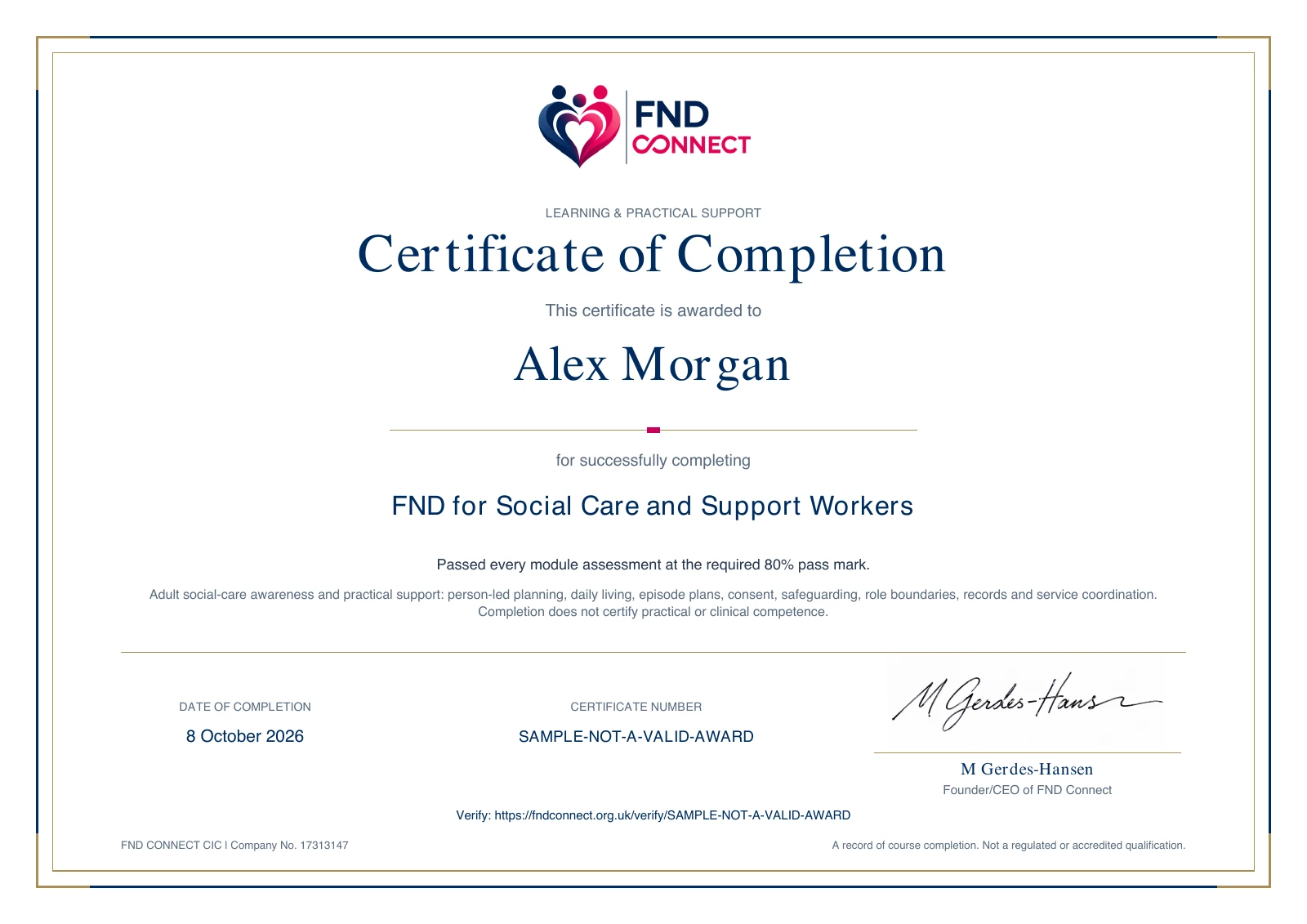
- A named Certificate of Completion with a unique verification record
Course coverage: Understanding FND; person-led support; daily living and communication; functional seizures and episode plans; consent and safeguarding; medicines boundaries; records and handovers; and reliable service coordination.
Allow around 4 hours for reading, reflection and the suggested activities, plus assessment time. This is an estimate, not verified CPD credit. Pause and return whenever you need.
The workbook is available after enrolment. Activities are self-directed, with worked examples; they are not individually marked. Adult social-care awareness and practical support. Follow the person's agreed plans, your role, training and local procedures. This course does not qualify you to diagnose FND, prescribe, administer medicines, perform transfers or deliver specialist therapy. It does not replace first aid, safeguarding training, the Care Certificate or workplace competency assessment. Use fictional details in exercises.
Try a scenario from the course
The library visit
Imani wants to attend a weekly library group. The plan says ‘promote independence’, but transport, support time and a harder-day option are missing. Two workers give conflicting advice about using a wheelchair. The coordinator proposes cancelling all outings until Imani can walk reliably.
Think it through: Identify the information needed for a usable outing plan.
Read the worked response
Ask Imani what matters about the group and which options are acceptable. Clarify transport, timing, access, agreed assistance and contingency contacts. Seek the relevant assessor's advice about mobility equipment and transfer needs; workers should not resolve the disagreement by removing an aid. Agree a feasible interim option with Imani and the appropriate team, and give someone responsibility for resolving the outstanding questions. Record whether service arrangements, rather than symptoms alone, are preventing participation.
Each of the 8 modules includes a practical activity with a worked response.
FND social care training: course modules
Understanding FND in everyday care
Belief, fluctuating needs and the value of social care
Learning outcomes and activity
- Explain FND without blame
- Describe how changing symptoms affect support needs
- Separate the support worker's role from clinical diagnosis
Practise: The good-day assumption
Planning support around the person
Goals, choices, flexibility and usable care plans
Learning outcomes and activity
- Translate priorities into practical support
- Recognise an incomplete or contradictory care plan
- Agree responsibilities and review arrangements
Practise: The library visit
Supporting daily living with changing symptoms
Personal care, movement, communication and fatigue
Learning outcomes and activity
- Match everyday assistance to assessed needs
- Protect dignity and communication during symptoms
- Recognise when changed needs require review
Practise: The rushed morning
Functional seizures and episode plans
Familiar events, uncertainty and emergency escalation
Learning outcomes and activity
- Find and follow the relevant individual episode plan
- Recognise when an episode needs urgent help
- Record observations without attempting diagnosis
Practise: An unfamiliar event
Consent, choice and safeguarding
Supporting decisions and responding to concerns
Learning outcomes and activity
- Support accessible decision-making
- Recognise safeguarding concerns without assumptions about FND
- Identify the correct local legal and reporting framework
Practise: The complaint nobody records
Medicines and role boundaries
Safe support, clinical questions and delegated tasks
Learning outcomes and activity
- Recognise the limits of medicines support
- Escalate unclear instructions and health changes
- Distinguish awareness learning from practical competence
Practise: The tablet in yoghurt
Records, handovers and information sharing
Useful observations and clear follow-through
Learning outcomes and activity
- Write factual and respectful records
- Make handovers actionable
- Protect private information while sharing what is needed
Practise: Rewrite the handover
Coordinating reliable FND support
Continuity, reviews and service improvement
Learning outcomes and activity
- Plan continuity across workers and services
- Escalate gaps in an agreed support package
- Turn learning into a measurable service improvement
Practise: Friday's discharge
How it works
Enrol
Pay once with your name and email. You'll get a private link to your course — no account or password needed.
Learn & test
Work through 8 modules at your own pace and pass a short test at the end of each (retake as often as you need).
Receive your certificate
Pass every module and download your Certificate of Completion — uniquely numbered and publicly verifiable.
A record of what you have completed
Pass every module at 80% to earn your FND for Social Care and Support Workers.
Download a named Certificate of Completion with your completion date, a unique certificate number and a public verification link. Retakes are unlimited and included in your course price.
Issued by FND CONNECT CIC. This is not a regulated qualification or external CPD accreditation.
Research and guidance behind the course
Published by FND Connect (FND CONNECT CIC). Edition 2026.10; source links checked 8 October 2026. The modules distinguish research findings, professional guidance and local service examples. Selected reading includes:
- NHS inform: Functional Neurological Disorder — Patient information on FND; not an individual diagnosis or care plan.
- NICE NG252: rehabilitation for chronic neurological disorders — Includes FND; rehabilitation recommendations require appropriate professional assessment.
- HSE: managing moving and handling risks — Requires individual assessment, suitable equipment and staff competence; this course is not handling training.
- NICE NG67: medicines support in community social care — For adults receiving community social care; care homes have separate medicines guidance.
- CQC Regulation 9: person-centred care — Applies to regulated providers in England; not a UK-wide regulatory framework.
Full references are included in the modules and workbook. Linking to a source does not imply its authors or organisation endorse this course. The source check is not independent clinical review or accreditation.
Use your learning in supervision and development
Record your actual learning time, discuss the scenarios in supervision and identify a practical improvement for your service. This course is not externally CPD-accredited, does not award verified CPD hours and does not replace the Care Certificate, mandatory training or workplace competency assessment.
Your Certificate of Completion records passing the online assessments. Check how your employer recognises this learning before enrolling if a particular qualification or accreditation is required.
Frequently asked questions
Who is the FND social care training course for?
For staff and managers supporting adults in home care, supported living and personal-assistant arrangements. No prior FND knowledge is required. This is awareness and practical support education; it does not qualify you to diagnose FND, prescribe, administer medicines, perform transfers or deliver specialist therapy. Follow individual plans, your competence and local procedures.
What is included in the £69 course price?
8 online modules, a test for each module, unlimited retakes and a downloadable Certificate of Completion when you pass every module. A printable workbook with eight fictional care scenarios, worked responses, source links and eight templates covering support planning, daily living, episode-plan readiness, consent and safeguarding, role boundaries, handovers and service continuity. Use fictional details only. This is a one-off payment per person, not a subscription.
How long does the course take?
Allow around 4 hours for reading, reflection and the suggested activities, plus assessment time. This is an estimate, not verified CPD credit. Study at your own pace and return using your private access link.
Is this accredited FND CPD social care training?
No. The course is not externally CPD-accredited and does not award verified CPD hours or points. You may be able to include the learning and your reflections in a development record, subject to your employer's or professional body's rules. Check those requirements before enrolling if accreditation is essential to you.
How do I earn the certificate?
Pass each module assessment with at least 80%. You can retake tests as often as you need. Your downloadable Certificate of Completion shows your name, the course, completion date and a unique certificate number with a public verification link. It is issued by FND CONNECT CIC and is not a regulated or accredited qualification.
Is this live training or a video course?
It is self-paced learning through written modules, diagrams, practical scenarios and short tests. Workbook activities are self-directed and include worked responses; they are not individually marked. There are no scheduled live sessions.
What happens after payment?
After successful payment, you can access your course through a private link, which is also emailed to you. You do not need to create an account or password. Use your own name and email so your access and certificate are correctly assigned.
Is this suitable for care managers and coordinators as well as support workers?
Yes. Alongside everyday support, the course covers visit planning, competent cover, access to current care plans, missed visits, handovers, referral follow-up and service review. Each learner can apply the exercises to their own role and responsibilities.
Does this course cover children or adults?
This course focuses on adult social care. FND Connect has a separate paediatric healthcare course and a schools course. The adult course's legal and safeguarding examples must not be treated as children's-care guidance.
Is the guidance the same across the UK?
No. The course identifies jurisdiction limits: CQC regulations and Care Act arrangements relate to England; Wales, Scotland and Northern Ireland have their own relevant frameworks. Learners must use the law, safeguarding routes and local policies applicable to their setting.
Does the certificate replace the Care Certificate or mandatory training?
No. It records completion of this FND course and its assessments. First aid, safeguarding, medicines, moving and handling, induction and role-specific competence require the appropriate separate training and assessment. The course does not certify a provider's regulatory compliance.
Can our care agency book a team?
Yes. Use the team booking option to add each colleague's name and email and pay once. Each learner receives a private access link, their own progress record and their own certificate after passing. The price is £69 per learner.
Enrol in FND social care training
£69 per person, paid once. Includes all 8 modules, workbook, tests, retakes and your certificate after passing.