
FND Connect · Online learning
FND training for adult healthcare teams
Clinical reasoning, clear communication and coordinated care for adults with FND.
12 modules · printable workbook · completion certificate
£99 per person · one-off payment
Develop your approach to Functional Neurological Disorder (FND) in adult healthcare. This in-depth, self-paced online course connects diagnostic reasoning, symptom understanding and evidence appraisal with the everyday decisions faced by nurses, GPs and community healthcare teams.
- Explain a positive FND diagnosis, recognise diagnostic uncertainty and assess new symptoms without diagnostic overshadowing.
- Review functional-seizure plans, medicines and rehabilitation needs while respecting professional scope and referral boundaries.
- Coordinate care with the adult, appraise treatment evidence and develop an accountable plan through twelve clinical cases.
FND education for nurses, GPs and community clinicians
Course: FND for Adult Healthcare Teams
For registered nurses, general practitioners (GPs), community nurses, allied health professionals and multidisciplinary adult healthcare teams. The course assumes existing clinical training and uses professional terminology, clinical uncertainty and complex cases. It is not an introductory care-worker course.
Professional clinical education: For nurses, GPs and adult community healthcare professionals with existing clinical training. No specialist FND experience is required, but this course assumes professional assessment and care responsibilities. Apply your competence, supervision, current guidance and local pathways. It does not certify clinical competence or replace specialist assessment.
Supporting a relative or friend outside a paid care role? Our family carers course is free.
What your £99 includes
Twelve in-depth modules for nurses, GPs and adult community healthcare teams. Allow around nine hours for reading, linked guidance and case reflection, plus assessment time; this is an estimate, not verified CPD credit.
- Twelve professional-level written modules with clinical reasoning sequences and linked guidance
- Twelve fictional case conferences with worked clinical responses
- 120 assessment questions with explanations; 80% in every module and unlimited retakes
- A printable workbook with twelve clinical reflection and planning templates
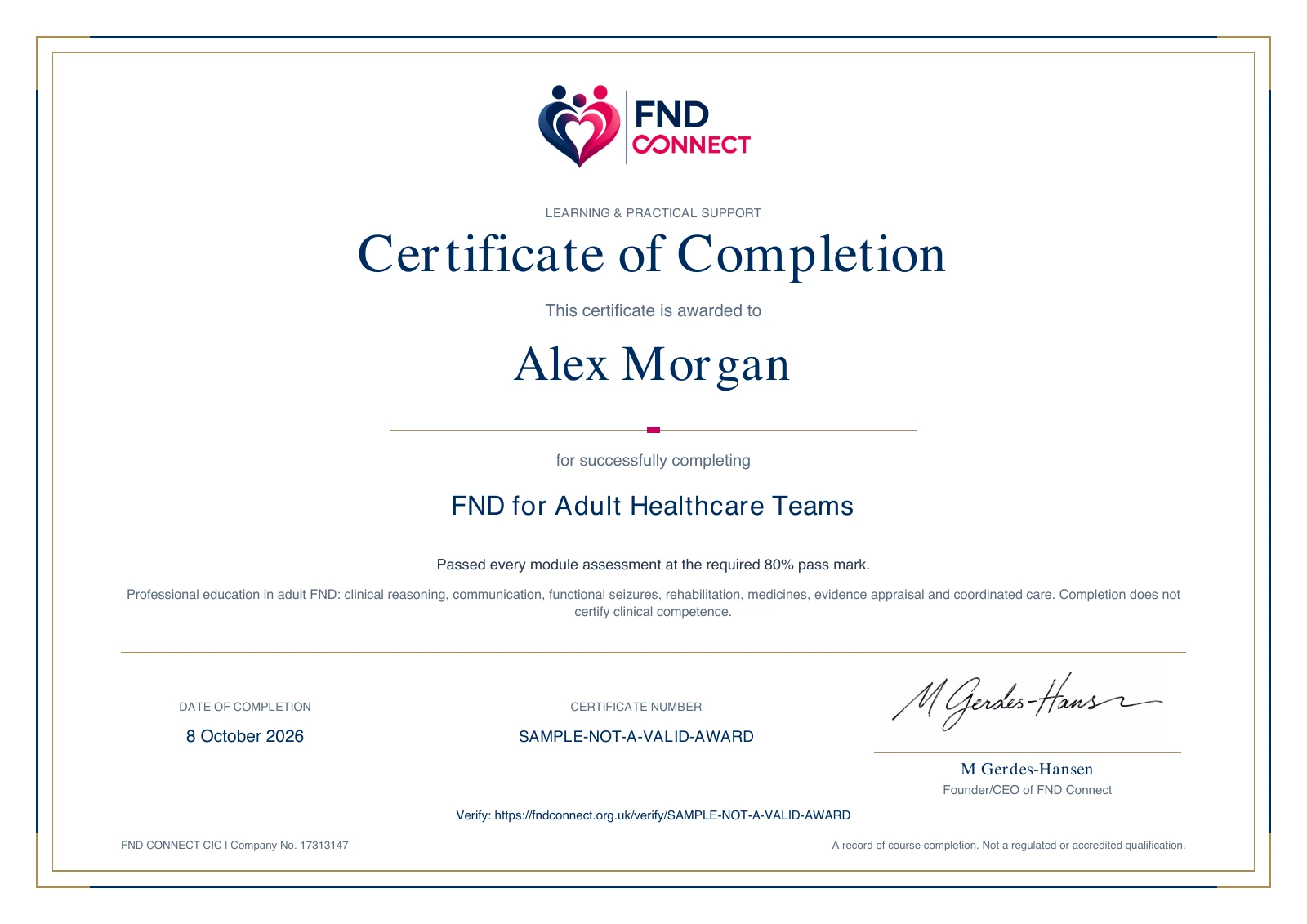
- A named FND for Adult Healthcare Teams Certificate of Completion with a unique verification record
Course coverage: Clinical formulation; positive diagnosis and differential; communication and shared decisions; acute change; functional seizures; medicines; motor rehabilitation; cognition, communication and swallowing; pain, fatigue and mental health; referral boundaries; evidence appraisal; and a complex-case capstone.
Allow around 9 hours for reading, reflection and the suggested activities, plus assessment time. This is an estimate, not verified CPD credit. Pause and return whenever you need.
The workbook is available after enrolment. Activities are self-directed, with worked examples; they are not individually marked. Professional education for nurses, GPs and adult community healthcare teams with existing clinical training. Apply your competence, supervision, current clinical guidance and local pathways. This course does not credential diagnosis, prescribing, specialist therapy or emergency care. Sources have been checked; the course has not undergone independent clinical peer review. Cases and workbook responses are fictional teaching examples, not patient-specific protocols.
Try a scenario from the course
The normal scan shortcut
A GP receives a discharge letter saying ‘MRI normal, likely FND’ after a patient developed limb weakness. No positive signs or follow-up are described. Six weeks later the patient reports a new pattern of symptoms. A colleague suggests copying the original diagnosis into all future referrals.
Think it through: Identify what the letter does and does not establish.
Read the worked response
The letter records a normal investigation and a provisional interpretation; it does not document a positive diagnosis. Assess the new presentation and its urgency on clinical grounds. Request clarification of the original phenotype, examination evidence, alternatives and follow-up. A referral should describe chronology and objective findings and ask the unresolved question explicitly. Preserve uncertainty in the record rather than upgrading the label. New disease and FND may coexist, so reviewing new evidence need not invalidate appropriate earlier findings.
Each of the 12 modules includes a practical activity with a worked response.
FND training for adult healthcare teams: course modules
Adult FND: mechanisms and clinical formulation
A neurological condition, an individual formulation and explicit uncertainty
Learning outcomes and activity
- Distinguish a diagnostic explanation from an individual causal formulation
- Map symptoms, coexisting illness and participation separately
- Identify the limits of mechanistic models and professional roles
Practise: One label, three different problems
Positive diagnosis and the differential
Clinical evidence, test limitations and diagnostic overshadowing
Learning outcomes and activity
- Explain what positive diagnostic evidence means
- Recognise limitations of examination signs and investigations
- Frame a referral that communicates uncertainty and competing diagnoses
Practise: The normal scan shortcut
Acute change and safety-netting
Avoiding both missed illness and unnecessary escalation
Learning outcomes and activity
- Assess change from an established baseline without diagnostic overshadowing
- Distinguish emergency action from planned review
- Write specific safety-netting and clinical handover
Practise: The unchanged label, changed presentation
Functional seizures: assessment and episode care
Event types, diagnostic confidence and a safe individual plan
Learning outcomes and activity
- Distinguish evidence about one event type from assumptions about all events
- Apply safe episode support and escalation boundaries
- Identify the information required for a specialist-authored seizure plan
Practise: Two events, one label
Medicines and preventing iatrogenic harm
Indications, reconciliation and supervised prescribing decisions
Learning outcomes and activity
- Separate treatment of functional seizures from valid coexisting indications
- Identify medication-related contributors and handover risks
- Plan a documented prescribing review without unsafe abrupt withdrawal
Practise: Three prescriptions, no owner
Motor rehabilitation and meaningful function
Movement retraining, participation and proportionate support
Learning outcomes and activity
- Explain the rationale of FND-informed motor rehabilitation
- Balance participation, equipment and safety without coercion
- Agree and review a functional goal across nursing and therapy teams
Practise: The wheelchair ultimatum
Cognition, communication and swallowing
Access to care, differential assessment and specialist boundaries
Learning outcomes and activity
- Assess the impact of cognitive and communication symptoms without assuming incapacity
- Recognise when swallowing or cognitive change needs further assessment
- Coordinate accessible care and relevant specialist input
Practise: An unanswered telephone is not refusal
Pain, fatigue, mental health and comorbidity
Treatable contributors, risk and a coherent whole-person plan
Learning outcomes and activity
- Assess associated symptoms without diagnostic overshadowing
- Distinguish a treatment target from an assumed cause of FND
- Prioritise physical and mental health needs with the person
Practise: Too many plans, too little capacity
Referral boundaries and coordinated care
Primary care continuity, MDT roles and accepted handovers
Learning outcomes and activity
- Select a referral question, destination and urgency
- Allocate responsibility while patients wait or cross services
- Write a handover that can be accepted, acted on and reviewed
Practise: The referral that nobody owned
Evidence appraisal and treatment choices
What trials support, what they do not and how to explain uncertainty
Learning outcomes and activity
- Distinguish guideline, consensus and trial claims
- Interpret primary and secondary outcomes without overstating benefit
- Discuss a treatment choice using relevance, uncertainty and patient priorities
Practise: The cure claim in the referral leaflet
Complex case review and service improvement
Consent, safeguarding, accountable follow-up and applying the learning
Learning outcomes and activity
- Integrate clinical uncertainty, autonomy and coordinated support in a complex case
- Distinguish safeguarding concern from assumptions about diagnosis or family roles
- Design a proportionate service improvement with a balancing measure
Practise: Capstone: a plan that works beyond the meeting
How it works
Enrol
Pay once with your name and email. You'll get a private link to your course — no account or password needed.
Learn & test
Work through 12 modules at your own pace and pass a short test at the end of each (retake as often as you need).
Receive your certificate
Pass every module and download your Certificate of Completion — uniquely numbered and publicly verifiable.
A record of what you have completed
Pass every module at 80% to earn your FND for Adult Healthcare Teams.
Download a named Certificate of Completion with your completion date, a unique certificate number and a public verification link. Retakes are unlimited and included in your course price.
Issued by FND CONNECT CIC. This is not a regulated qualification or external CPD accreditation.
Research and guidance behind the course
Published by FND Connect (FND CONNECT CIC). Edition 2026.10; source links checked 8 October 2026. The modules distinguish research findings, professional guidance and local service examples. Selected reading includes:
- NICE NG127: neurological recognition and referral in adults — Symptom-specific assessment and referral, including new symptoms in established FND. Apply current local pathways and urgency.
- NICE NG252: rehabilitation for chronic neurological disorders — 2025 guideline includes FND; read relevant recommendations, related condition guidance and local implementation arrangements.
- AAN (2025): management of functional seizures, clinician summary — US professional guideline, published December 2025; informs evidence discussion, not a UK emergency protocol or prescribing authority.
- Nielsen et al. (2024): Physio4FMD randomised trial — Specialist versus community neurological physiotherapy: distinguish the primary outcome from secondary findings.
- Goldstein et al. (2020): CODES randomised trial — Dissociative-seizure-specific CBT plus standardised medical care versus standardised medical care; not evidence about all forms of FND.
- NMC: The Code — Professional responsibilities, records, communication, referral and working within competence; not course accreditation.
Full references are included in the modules and workbook. Linking to a source does not imply its authors or organisation endorse this course. The source check is not independent clinical review or accreditation.
Use the learning in professional reflection
Allow around nine hours for reading, linked guidance and case reflection, plus assessment time. This is a study estimate, not verified CPD credit. The course is not externally CPD-accredited and does not award CPD points. Record your actual learning time and check your employer's or professional body's requirements.
Use the case conferences and workbook for self-directed reflection or team discussion. The Certificate of Completion records passing the online assessments; it does not credential diagnosis, prescribing, specialist therapy or emergency care. The course has not undergone independent clinical peer review.
Frequently asked questions
Who is the FND training for adult healthcare teams course for?
For nurses, GPs and adult community healthcare professionals with existing clinical training. No specialist FND experience is required, but this course assumes professional assessment and care responsibilities. Apply your competence, supervision, current guidance and local pathways. It does not certify clinical competence or replace specialist assessment.
What is included in the £99 course price?
12 online modules, a test for each module, unlimited retakes and a downloadable Certificate of Completion when you pass every module. A printable professional workbook with twelve fictional clinical cases, worked responses, source links and twelve templates for formulation, communication, safety-netting, episode-plan review, medicines, rehabilitation, MDT handover, evidence appraisal and service improvement. Use fictional information only. This is a one-off payment per person, not a subscription.
How long does the course take?
Allow around 9 hours for reading, reflection and the suggested activities, plus assessment time. This is an estimate, not verified CPD credit. Study at your own pace and return using your private access link.
Is this accredited FND CPD adult healthcare training?
No. The course is not externally CPD-accredited and does not award verified CPD hours or points. You may be able to include the learning and your reflections in a development record, subject to your employer's or professional body's rules. Check those requirements before enrolling if accreditation is essential to you.
How do I earn the certificate?
Pass each module assessment with at least 80%. You can retake tests as often as you need. Your downloadable Certificate of Completion shows your name, the course, completion date and a unique certificate number with a public verification link. It is issued by FND CONNECT CIC and is not a regulated or accredited qualification.
Is this live training or a video course?
It is self-paced learning through written modules, diagrams, practical scenarios and short tests. Workbook activities are self-directed and include worked responses; they are not individually marked. There are no scheduled live sessions.
What happens after payment?
After successful payment, you can access your course through a private link, which is also emailed to you. You do not need to create an account or password. Use your own name and email so your access and certificate are correctly assigned.
Does this cover FND diagnosis and referral for GPs?
Yes. The course examines positive diagnostic evidence, differential and coexisting conditions, limitations of investigations, new symptoms and focused referral questions. It supports clinical reasoning within existing competence; it does not qualify learners to perform or interpret specialist examinations independently.
What does the course cover for nurses and community teams?
Communication, changes from baseline, functional-seizure plans, medicines reconciliation, rehabilitation support, cognition, speech and swallowing concerns, pain, fatigue and mental health. Cases address professional roles, escalation, patient autonomy, accessible care and accepted MDT handovers.
How detailed is the adult healthcare course?
There are twelve modules and 120 assessment questions, with a clinical case and worked response in every module. Dedicated sections examine treatment evidence, including Physio4FMD and CODES, and a final complex-case exercise brings assessment, coordination and service improvement together. Each module requires an 80% pass, with unlimited retakes.
Is the course clinically peer-reviewed or accredited?
No. Sources were checked on 8 October 2026, but this course has not undergone independent clinical peer review and is not externally CPD-accredited. It identifies guidance, expert consensus and trial evidence, with source links and limitations. Completion is educational and does not demonstrate supervised clinical competence.
Does it provide prescribing or emergency treatment protocols?
No. It teaches how to recognise the boundaries of an established plan, identify questions for review and coordinate appropriate care. Individual prescribing, medicine withdrawal, rescue treatment and emergency responses require competent clinical judgement, current guidance and local protocols.
Can our practice or community team book together?
Yes. Team booking costs £99 per learner. Add each colleague's name and email and pay once. Each learner receives private access, separate progress and their own certificate after passing every module. A two-person booking costs £198.
Enrol in FND training for adult healthcare teams
£99 per person, paid once. Includes all 12 modules, workbook, tests, retakes and your certificate after passing.