

FND Connect · Online learning
Paediatric FND training
Online FND training for healthcare professionals supporting children and adolescents.
10 modules · printable workbook · completion certificate
£99 per person · one-off payment
Develop your understanding of Functional Neurological Disorder (FND) in children and young people through a practical, self-paced online course. Explore assessment boundaries, communication, functional seizures and multidisciplinary rehabilitation, with ten modules and clinical scenarios for paediatric healthcare teams.
- Explain FND respectfully and recognise when clinical uncertainty or new symptoms require assessment.
- Connect episode plans, rehabilitation, family support and school participation across the team.
- Practise with ten clinical scenarios and build a clear plan for follow-up and transition.
FND in children and adolescents: who this course is for
Course: Paediatric FND: Understanding and Supporting Children and Young People
Designed for paediatric nurses, paediatricians and other doctors, physiotherapists, occupational therapists, speech and language therapists, psychologists and community healthcare professionals. Build shared understanding across your multidisciplinary team, with examples focused on children, adolescents and their families.
Professional foundation: For paediatric healthcare professionals and relevant community teams. This is a foundation course with clinical context; it does not certify competence to diagnose FND, prescribe, deliver specialist therapy or manage emergencies independently. Follow your professional scope, supervision and local policies.
Supporting a pupil as a teacher or SENCO? Explore our FND training for school staff. Supporting a relative or friend outside a paid care role? Our family carers course is free.
What your £99 includes
Ten modules for paediatric healthcare teams, with source-linked learning, clinical scenarios and practical prompts for coordinated care.
- Ten in-depth written modules with source links and practical diagrams
- Ten clinical scenarios with guided activities and worked responses
- 80 assessment questions with explanations, an 80% pass mark and unlimited retakes
- A printable workbook with eight team-planning templates
- A named Certificate of Completion with a unique verification record
Course coverage: Positive diagnosis and its limits; communication; functional seizures; new symptoms; multidisciplinary rehabilitation; coexisting needs; safeguarding; school liaison; and transition.
Allow around 6 hours for reading, reflection and the suggested activities, plus assessment time. This is an estimate, not verified CPD credit. Pause and return whenever you need.
The workbook is available after enrolment. Activities are self-directed, with worked examples; they are not individually marked. Professional foundation education for paediatric healthcare teams. Work within your competence, supervision and local policies. Completion does not establish competence to diagnose FND, prescribe, deliver a specialist therapy or manage emergencies independently. New or different symptoms must not automatically be attributed to FND. Use fictional details in learning activities.
Try a scenario from the course
The old diagnosis and the new weakness
Beth, 12, has an established functional tremor. She now has a sudden new facial weakness. A handover says ‘known FND; reassure’.
Think it through: Identify what the existing diagnosis does and does not establish.
Read the worked response
The tremor diagnosis does not explain a new sudden facial weakness. Escalate promptly through the appropriate paediatric neurological/acute pathway. State onset, observed findings, associated concerns and what is different; include the prior diagnosis as context, not a conclusion. NICE recommends immediate neurological assessment for sudden or rapidly progressive limb or facial weakness in children. Reassure Beth that the team is taking the change seriously while arranging assessment.
Each of the 10 modules includes a practical activity with a worked response.
Paediatric FND training: course modules
Understanding paediatric FND
Symptoms, development and realistic hope
Learning outcomes and activity
- Explain genuine, involuntary symptoms without blame
- Distinguish FND presentations from associated needs
- Interpret outcome claims without promising recovery
Practise: A normal scan, an unanswered question
Assessment and diagnostic boundaries
Positive diagnosis, uncertainty and coexisting disease
Learning outcomes and activity
- Describe the role and limits of positive clinical features
- Recognise uncertainty and coexisting disease
- Prepare a useful assessment or referral summary
Practise: The old diagnosis and the new weakness
Functional seizures and episode care
Individual plans, calm responses and clinical uncertainty
Learning outcomes and activity
- Distinguish a familiar documented event from an undifferentiated episode
- Describe appropriate specialist assessment and epilepsy overlap
- Identify the requirements of an individual episode plan
Practise: Two event types, one incomplete handover
New symptoms and acute deterioration
Preventing diagnostic overshadowing
Learning outcomes and activity
- Identify when an existing diagnosis does not answer a new concern
- Use local acute-care and age-appropriate referral pathways
- Give a concise escalation handover
Practise: An event after a head injury
Coordinated rehabilitation
Individual goals and clear multidisciplinary roles
Learning outcomes and activity
- Explain complementary professional roles
- Translate participation goals into a coordinated plan
- Interpret treatment evidence and recognise scope limits
Practise: Conflicting activity advice
Coexisting needs and accessible care
Pain, fatigue, communication and neurodevelopment
Learning outcomes and activity
- Identify needs requiring assessment in their own right
- Adapt encounters to communication and sensory needs
- Avoid using psychological or neurodevelopmental findings as diagnostic proof
Practise: The busy clinic
Young people, families and safeguarding
Voice, confidentiality and proportionate action
Learning outcomes and activity
- Include the young person's priorities alongside family support
- Recognise consent and confidentiality questions requiring guidance
- Respond to safeguarding concerns without assumptions based on FND
Practise: A request to talk privately
School, friendships and participation
Linking clinical care with the young person's everyday life
Learning outcomes and activity
- Coordinate clinically informed support with education staff
- Set individual participation goals
- Share useful information proportionately and review its effect
Practise: ‘Return when the episodes stop’
Follow-up and transition
Continuity, review and bringing the course together
Learning outcomes and activity
- Review symptoms, function and participation separately
- Plan responsibility across service transitions
- Apply course learning to a complete team case
Practise: The referral that has not been accepted
How it works
Enrol
Pay once with your name and email. You'll get a private link to your course — no account or password needed.
Learn & test
Work through 10 modules at your own pace and pass a short test at the end of each (retake as often as you need).
Receive your certificate
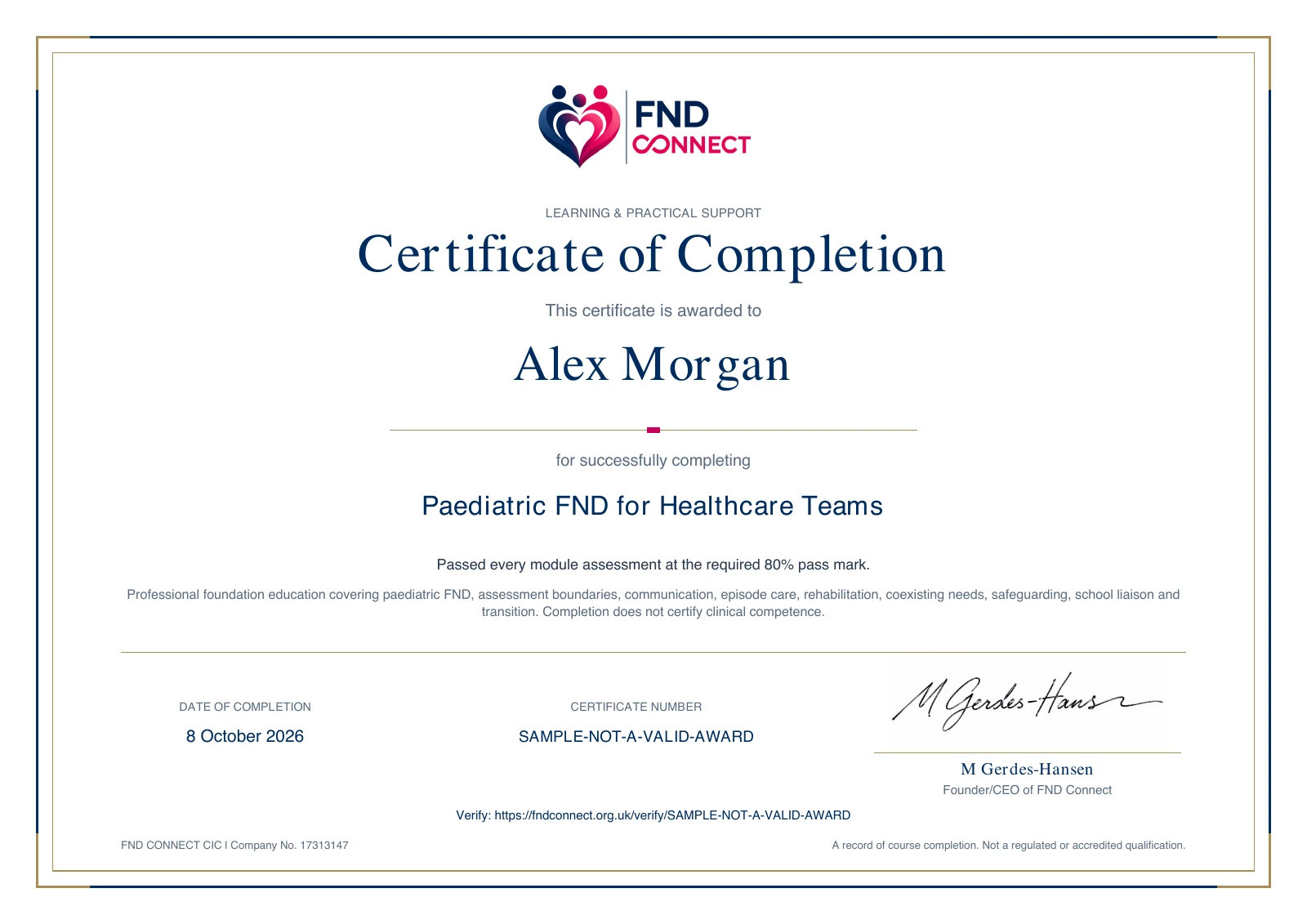
Pass every module and download your Certificate of Completion — uniquely numbered and publicly verifiable.
A record of what you have completed
Pass every module at 80% to earn your Paediatric FND for Healthcare Teams.
Download a named Certificate of Completion with your completion date, a unique certificate number and a public verification link. Retakes are unlimited and included in your course price.
Issued by FND CONNECT CIC. This is not a regulated qualification or external CPD accreditation.
Research and guidance behind the course
Published by FND Connect (FND CONNECT CIC). Edition 2026.10; source links checked 8 October 2026. The modules distinguish research findings, professional guidance and local service examples. Selected reading includes:
- Vassilopoulos et al. (2022): treatment approaches in children — Narrative review; supports individualised coordinated care, not a universal protocol.
- Reilly et al. (2023): ILAE consensus on functional seizures in children — Scoping review and expert consensus specific to paediatric functional seizures.
- NICE NG127: neurological recognition and referral in under-16s — General referral guidance; use the appropriate age-specific and local pathway.
- NICE NG43: transition from children's to adults' services — General transition guidance, not an FND-specific guarantee of adult provision.
Full references are included in the modules and workbook. Linking to a source does not imply its authors or organisation endorse this course. The source check is not independent clinical review or accreditation.
Reflecting on your paediatric FND learning
Continuing professional development (CPD) can include self-directed learning where your employer or professional body accepts it. This course is not externally CPD-accredited and does not award verified CPD hours or points. Record the time you actually spend learning and check your organisation's requirements.
Record your actual study time, reflect on the cases and discuss one practice change and one remaining learning need with your supervisor or team.
Frequently asked questions
Who is the Paediatric FND training course for?
For paediatric healthcare professionals and relevant community teams. This is a foundation course with clinical context; it does not certify competence to diagnose FND, prescribe, deliver specialist therapy or manage emergencies independently. Follow your professional scope, supervision and local policies.
What is included in the £99 course price?
10 online modules, a test for each module, unlimited retakes and a downloadable Certificate of Completion when you pass every module. A printable team workbook with ten clinical scenarios, worked responses, source links and eight templates for explanation, episode-plan requirements, MDT goals, school liaison and transition. Use fictional details for learning. This is a one-off payment per person, not a subscription.
How long does the course take?
Allow around 6 hours for reading, reflection and the suggested activities, plus assessment time. This is an estimate, not verified CPD credit. Study at your own pace and return using your private access link.
Is this accredited FND CPD paediatric training?
No. The course is not externally CPD-accredited and does not award verified CPD hours or points. You may be able to include the learning and your reflections in a development record, subject to your employer's or professional body's rules. Check those requirements before enrolling if accreditation is essential to you.
How do I earn the certificate?
Pass each module assessment with at least 80%. You can retake tests as often as you need. Your downloadable Certificate of Completion shows your name, the course, completion date and a unique certificate number with a public verification link. It is issued by FND CONNECT CIC and is not a regulated or accredited qualification.
Is this live training or a video course?
It is self-paced learning through written modules, diagrams, practical scenarios and short tests. Workbook activities are self-directed and include worked responses; they are not individually marked. There are no scheduled live sessions.
What happens after payment?
After successful payment, you can access your course through a private link, which is also emailed to you. You do not need to create an account or password. Use your own name and email so your access and certificate are correctly assigned.
Does the course cover functional seizures in children?
Yes. A dedicated module covers paediatric functional seizures, also described as dissociative or non-epileptic seizures, and individual episode plans. It explores communication, coexisting epilepsy, uncertainty and when to escalate concerns. This is foundation education; it does not replace an individual clinical plan or emergency training.
Is this FND course suitable for physiotherapists and occupational therapists?
Yes. Physiotherapists, occupational therapists and other allied health professionals can use the course to develop a shared understanding of paediatric FND, coordinated rehabilitation, accessible care and participation at home and school. It explains team roles and planning; it is not specialist certification in delivering FND treatment.
Can a paediatric department or multidisciplinary team enrol together?
Yes. Choose the team booking option to enter each colleague's name and email and pay for everyone in one transaction. Each learner receives their own access link, progress record, assessments and Certificate of Completion after passing. The price is £99 per learner.
Enrol in Paediatric FND training
£99 per person, paid once. Includes all 10 modules, workbook, tests, retakes and your certificate after passing.