

FND Connect · Online learning
FND schools training
Support a pupil with FND through the school day.
8 modules · printable workbook · completion certificate
£49 per person · one-off payment
Practical Functional Neurological Disorder training for teachers, SENCOs, teaching assistants and pastoral staff — from symptom-specific support to learning, transitions and exams.
- Respond calmly when symptoms interrupt lessons or transitions.
- Plan learning access, safe spaces and everyday adjustments with the pupil and family.
- Turn shared information into a pupil-support plan that staff can use.
What your £49 includes
Practical support for the whole school day: symptom-specific actions, lesson and exam access, healthcare planning, family communication and inclusive participation.
- Eight expanded lessons with symptom-specific support and setting-specific examples
- Eight guided planning activities with worked responses
- Module knowledge checks, an 80% pass mark and unlimited retakes
- A printable practice workbook with support-plan, adjustment and review prompts
- A numbered Certificate of Completion with an online verification record
Symptom-specific support: weakness and falls; tremor, jerks and spasms; speech and voice; brain fog; fatigue and pain; dizziness and sensory overload; visual and sensory changes; swallowing difficulties; and functional seizures.
Allow around 6 hours for reading, reflection and the suggested activities, plus assessment time. This is an estimate, not verified CPD credit. Pause and return whenever you need.
The workbook is available after enrolment. Activities are self-directed, with worked examples; they are not individually marked. This course supports everyday inclusion and does not replace first-aid training, clinical advice or individual legal advice.
Try a scenario from the course
The crowded corridor
After a noisy lunch, a pupil develops familiar dizziness, leg weakness and difficulty speaking. They show their agreed help card. Their next classroom is upstairs.
Think it through: What should the nearest adult do now?
Read the worked response
Use one calm adult, make space and offer a safe place to sit. Follow the plan and seek first-aid or emergency help if indicated. Do not send the pupil upstairs or to the medical room alone. Offer pointing or writing and arrange appropriate adult support. Later review a quieter lunch, different transition timing, an accessible classroom and staff awareness of the help card, with the pupil and family.
Each of the 8 modules includes a practical activity with a worked response.
FND schools training: course modules
Understanding FND in Children
What FND is, why it happens, and why it's genuine
Learning outcomes and activity
- Explain in plain terms what FND is and how common it is in young people
- Describe why a child's FND symptoms are genuine and involuntary
- Outline what is known about causes, treatment and outlook in children
- Challenge common myths about FND in a school setting
- Explain FND without blaming the child or taking on a clinical role
Practise: The pupil who looks fine
FND in the School Day
Symptoms, triggers and what to look out for
Learning outcomes and activity
- Recognise how FND can present in school
- Understand fluctuation and masking
- Identify common triggers to watch for
- Match support to eight symptom groups across lessons and transitions
Practise: The crowded corridor
Functional Seizures & Episode Response
Keeping the child safe and dignified when symptoms escalate
Learning outcomes and activity
- Recognise what functional seizures and dissociative episodes look like in pupils
- Respond step by step, including what never to do
- Know when to call 999 rather than follow the usual plan
- Manage the classroom, peers and recovery around an episode
- Coordinate a safe response, including airway, emergency calls and recovery
Practise: An episode during lunch
Legal Duties & the SEND Framework
Your responsibilities and the support systems
Learning outcomes and activity
- Understand schools' duties to disabled pupils
- Know the SEND/ALN/ASN routes and the SENCO's role
- Know what support can be requested from the LA or EA
- Distinguish medical, learning and attendance plans and check national scope
Practise: Waiting for an assessment
Plans, TA Support & a Safe Space
Healthcare plans, emergency plans and practical adjustments
Learning outcomes and activity
- Describe what an Individual Healthcare Plan and emergency plan cover
- Know how TA/one-to-one support and a safe space help
- Identify practical reasonable adjustments for a pupil with FND
- Make a support plan work for supply staff, trips, evacuation and personal care
Practise: The trip checklist
Learning, Cognition & Exams
Teaching a pupil whose brain fog, fatigue and symptoms affect learning
Learning outcomes and activity
- Understand how cognitive FND symptoms affect classroom learning
- Apply teaching strategies that reduce cognitive and sensory load
- Plan homework, assessment and catch-up around fluctuating capacity
- Use exam access arrangements and technology effectively
- Adapt a lesson and assessment while preserving the learning goal
Practise: Keep the learning goal
Recording, Communication & Working with Parents
Keeping records and working as a team
Learning outcomes and activity
- Record episodes and symptoms consistently
- Communicate well with parents and keep them informed
- Work as a team while respecting confidentiality
- Record observations, share proportionately and resolve conflicting accounts
Practise: Two accounts that seem inconsistent
Putting It Into Practice
Agreed plans, scenarios and next steps
Learning outcomes and activity
- Pull the elements together into an agreed plan
- Apply the learning to realistic school scenarios
- Know where to get further help
- Build and rehearse a pupil-centred plan for a full school day
Practise: Make the plan usable tomorrow
How it works
Enrol
Pay once with your name and email. You'll get a private link to your course — no account or password needed.
Learn & test
Work through 8 modules at your own pace and pass a short test at the end of each (retake as often as you need).
Receive your certificate
Pass every module and download your Certificate of Completion — uniquely numbered and publicly verifiable.
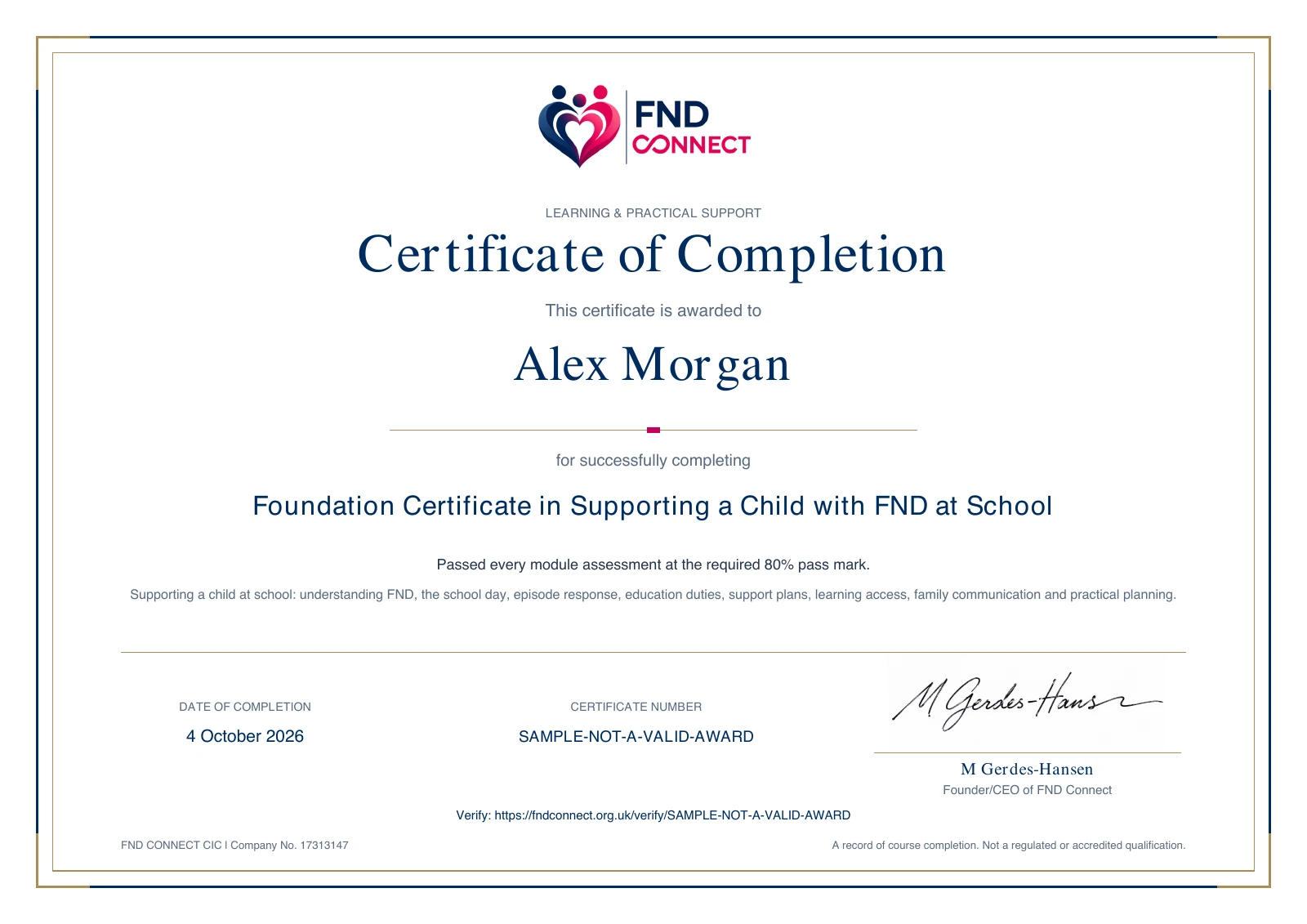
A record of what you have completed
Pass every module at 80% to earn your Foundation Certificate in Supporting a Child with FND at School.
Download a named Certificate of Completion with your completion date, a unique certificate number and a public verification link. Retakes are unlimited and included in your course price.
Issued by FND CONNECT CIC. This is not a regulated qualification or external CPD accreditation.
Using FND schools training for CPD
CPD usually means continuing professional development. If you are searching for FND continuous personal development training, these courses offer structured, self-directed learning that you can discuss with your employer or professional body for your development record. They are not externally CPD-accredited and do not award verified CPD hours or points. Acceptance depends on your organisation's requirements.
Record the time you actually spend learning, reflect on a classroom scenario and identify one change to discuss with your SENCO or pastoral team.
Frequently asked questions
Who is the FND schools training course for?
This FND schools online course is for teachers, SENCOs, teaching assistants, pastoral teams and other school staff supporting a pupil with FND. No prior FND knowledge is required. It focuses on everyday school support; it does not qualify you to diagnose or treat FND.
What is included in the £49 course price?
8 online modules, a test for each module, unlimited retakes and a downloadable Certificate of Completion when you pass every module. A printable pupil-support workbook with eight scenario activities, worked responses, symptom-support prompts, an episode-response planning template and a practical support-plan template. This is a one-off payment per person, not a subscription.
How long does the course take?
Allow around 6 hours for reading, reflection and the suggested activities, plus assessment time. This is an estimate, not verified CPD credit. Study at your own pace and return using your private access link.
Is this accredited FND CPD schools training?
No. The course is not externally CPD-accredited and does not award verified CPD hours or points. You may be able to include the learning and your reflections in a development record, subject to your employer's or professional body's rules. Check those requirements before enrolling if accreditation is essential to you.
How do I earn the certificate?
Pass each module assessment with at least 80%. You can retake tests as often as you need. Your downloadable Certificate of Completion shows your name, the course, completion date and a unique certificate number with a public verification link. It is issued by FND CONNECT CIC and is not a regulated or accredited qualification.
Is this live training or a video course?
It is self-paced learning through written modules, diagrams, practical scenarios and short tests. Workbook activities are self-directed and include worked responses; they are not individually marked. There are no scheduled live sessions.
What happens after payment?
After successful payment, you can access your course through a private link, which is also emailed to you. You do not need to create an account or password. Use your own name and email so your access and certificate are correctly assigned.
Enrol in FND schools training
£49 per person, paid once. Includes all 8 modules, workbook, tests, retakes and your certificate after passing.