

FND Connect · Online learning
FND training for colleges and universities
Practical support for students with FND, from teaching and exams to placements and campus life.
8 modules · printable workbook · completion certificate
£69 per person · one-off payment
Support students with Functional Neurological Disorder (FND) through further and higher education. This self-paced online course helps staff turn conversations about access into practical arrangements while respecting student choice and autonomy.
- Plan accessible teaching, attendance and assessment with the student and responsible teams.
- Coordinate support for placements, accommodation and episodes while respecting student autonomy.
- Make adjustment plans actionable, review their delivery and explain appropriate routes for unresolved concerns.
Who is this FND course for?
Course: FND in Colleges and Universities
For disability advisers, lecturers, tutors, student-services staff, examinations teams, placement coordinators and accommodation teams in colleges and universities. Includes post-16 settings with under-18s as well as adult students, with clear safeguarding and jurisdiction boundaries.
Post-16 staff foundation: For staff supporting students in further and higher education, including disability advisers, lecturers and student services. No prior FND knowledge is required. This is awareness and practical planning education, not clinical training or individual legal advice. Use the procedures and professional requirements applicable to your institution, qualification and UK nation.
Working in a school setting? Explore our FND training for school staff.
What your £69 includes
Eight practical modules for disability advisers, lecturers and student-services teams supporting students with FND in colleges and universities.
- Eight written modules with source links and practical decision sequences
- Eight fictional student scenarios with worked responses
- 64 assessment questions with explanations, an 80% pass mark and unlimited retakes
- A printable workbook with eight planning templates
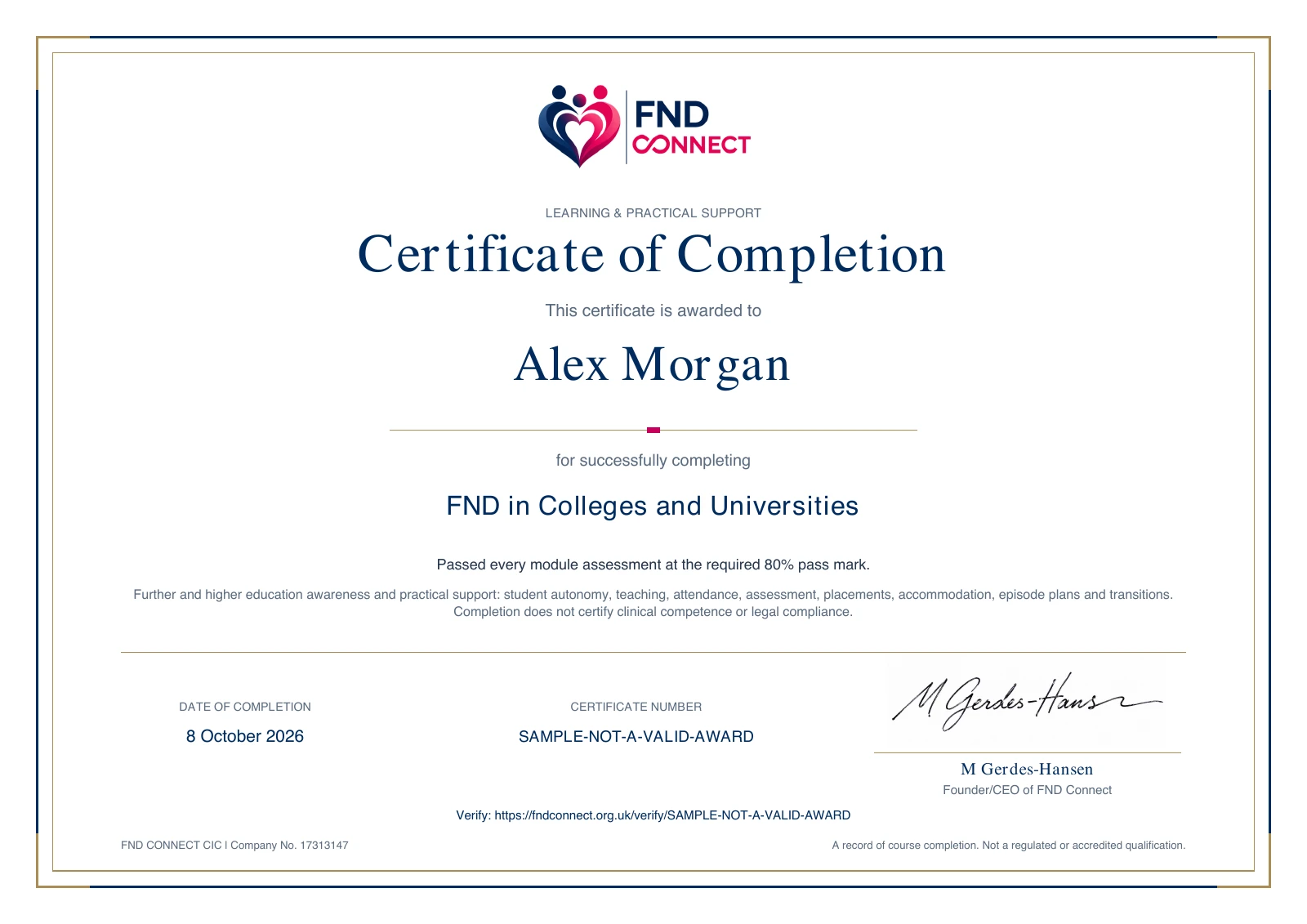
- A named Certificate of Completion with a unique verification record
Course coverage: FND understanding; student autonomy and support plans; teaching and attendance; exams and assessment; placements, labs and fieldwork; accommodation and campus life; episode response; and transitions, reviews and student voice.
Allow around 4 hours for reading, reflection and the suggested activities, plus assessment time. This is an estimate, not verified CPD credit. Pause and return whenever you need.
The workbook is available after enrolment. Activities are self-directed, with worked examples; they are not individually marked. For staff supporting students in further and higher education. This is awareness and practical planning education, not clinical training, legal advice or a qualification in disability assessment. It does not replace first aid, safeguarding, professional requirements or institutional procedures. Respect student autonomy and use fictional information in exercises.
Try a scenario from the course
The copied-in parent
Noah, 20, asks for a written support discussion because speech is difficult today. His mother is the emergency contact. A staff member proposes copying her into all emails and telling every lecturer his full history. Noah wants one adviser to coordinate specific adjustments.
Think it through: Identify assumptions about communication and consent.
Read the worked response
Use Noah's preferred written communication and ask whom he wants involved. An emergency contact is not blanket permission to share records. Agree the functional instructions each lecturer needs and who will send them through approved channels. Keep clinical detail restricted to those who need it. Name the action owner, completion date and route for reporting a missed adjustment. Explain any safeguarding or emergency limits to confidentiality without suggesting they justify routine broad disclosure.
Each of the 8 modules includes a practical activity with a worked response.
FND training for colleges and universities: course modules
Understanding FND in post-16 education
Belief, variation and barriers to participation
Learning outcomes and activity
- Explain FND without blame
- Identify barriers beyond the classroom
- Separate educational support from clinical diagnosis
Practise: Present online, absent in person
Student autonomy and support plans
Disclosure, consent and shared responsibilities
Learning outcomes and activity
- Keep the student involved in support decisions
- Distinguish necessary sharing from broad disclosure
- Create an actionable plan with review arrangements
Practise: The copied-in parent
Accessible teaching and attendance
Learning access, engagement and proportionate review
Learning outcomes and activity
- Identify barriers in teaching and timetables
- Plan workable participation and absence arrangements
- Recognise when specialist advice is needed before study changes
Practise: The attendance warning
Exams, assessment and standards
Access arrangements, practical delivery and additional consideration
Learning outcomes and activity
- Distinguish access arrangements from additional consideration
- Plan exam logistics with the responsible team
- Separate competence standards from assessment methods
Practise: Extra time but no breaks
Placements, labs and fieldwork
Task-specific planning and shared responsibilities
Learning outcomes and activity
- Plan access before a placement or practical activity
- Use individual risk assessment rather than diagnosis-based exclusion
- Clarify host, provider and student responsibilities
Practise: The placement starts on Monday
Accommodation and campus life
Living access, support boundaries and emergency planning
Learning outcomes and activity
- Explore barriers beyond teaching spaces
- Separate study support from personal-care arrangements
- Coordinate accommodation and evacuation planning with responsible teams
Practise: Accessible bedroom, inaccessible day
Episodes and campus response
Individual plans, first aid and dignified follow-up
Learning outcomes and activity
- Recognise when urgent help is needed
- Use individual episode plans within their scope
- Coordinate first-aid access and factual follow-up
Practise: An episode in the library
Transitions, reviews and student voice
Support that survives changes of course, team and setting
Learning outcomes and activity
- Plan transitions without assuming arrangements transfer automatically
- Review support using the student's experience
- Explain fair routes when support or decisions are disputed
Practise: New year, missing adjustments
How it works
Enrol
Pay once with your name and email. You'll get a private link to your course — no account or password needed.
Learn & test
Work through 8 modules at your own pace and pass a short test at the end of each (retake as often as you need).
Receive your certificate
Pass every module and download your Certificate of Completion — uniquely numbered and publicly verifiable.
A record of what you have completed
Pass every module at 80% to earn your FND in Colleges and Universities.
Download a named Certificate of Completion with your completion date, a unique certificate number and a public verification link. Retakes are unlimited and included in your course price.
Issued by FND CONNECT CIC. This is not a regulated qualification or external CPD accreditation.
Research and guidance behind the course
Published by FND Connect (FND CONNECT CIC). Edition 2026.10; source links checked 8 October 2026. The modules distinguish research findings, professional guidance and local service examples. Selected reading includes:
- NHS inform: Functional Neurological Disorder — FND information; not an individual diagnosis or support plan.
- EHRC: technical guidance on further and higher education — Equality Act 2010 guidance for Great Britain; Northern Ireland has separate legislation.
- Office for Students: student disability guide — Higher education in England; not a UK-wide regulator or an FE examination rulebook.
- Ofqual: what staff need to know before exams and assessments — Check the qualification's current awarding-body requirements; university assessment procedures are distinct.
- OIA: complaints relating to placements — Placement planning and responsibilities; professional and awarding-body requirements still need checking.
- ICO: sharing personal information in an emergency — ICO flags this guidance as under review following the Data (Use and Access) Act; use current institutional privacy and safeguarding advice.
Full references are included in the modules and workbook. Linking to a source does not imply its authors or organisation endorse this course. The source check is not independent clinical review or accreditation.
Apply your learning in student support
Use the scenarios in team discussions and record your actual learning time and reflections. This course is not externally CPD-accredited, does not award verified CPD hours and does not replace safeguarding, first-aid or role-specific training.
Your Certificate of Completion records passing the online assessments. It does not certify legal compliance, disability-assessment competence or authority to make clinical or professional-fitness decisions.
Frequently asked questions
Who is the FND training for colleges and universities course for?
For staff supporting students in further and higher education, including disability advisers, lecturers and student services. No prior FND knowledge is required. This is awareness and practical planning education, not clinical training or individual legal advice. Use the procedures and professional requirements applicable to your institution, qualification and UK nation.
What is included in the £69 course price?
8 online modules, a test for each module, unlimited retakes and a downloadable Certificate of Completion when you pass every module. A printable workbook with eight fictional student scenarios, worked responses, source links and eight planning templates covering support agreements, attendance, assessments, placements, accommodation, episode plans and transitions. Use fictional details only. This is a one-off payment per person, not a subscription.
How long does the course take?
Allow around 4 hours for reading, reflection and the suggested activities, plus assessment time. This is an estimate, not verified CPD credit. Study at your own pace and return using your private access link.
Is this accredited FND CPD college and university training?
No. The course is not externally CPD-accredited and does not award verified CPD hours or points. You may be able to include the learning and your reflections in a development record, subject to your employer's or professional body's rules. Check those requirements before enrolling if accreditation is essential to you.
How do I earn the certificate?
Pass each module assessment with at least 80%. You can retake tests as often as you need. Your downloadable Certificate of Completion shows your name, the course, completion date and a unique certificate number with a public verification link. It is issued by FND CONNECT CIC and is not a regulated or accredited qualification.
Is this live training or a video course?
It is self-paced learning through written modules, diagrams, practical scenarios and short tests. Workbook activities are self-directed and include worked responses; they are not individually marked. There are no scheduled live sessions.
What happens after payment?
After successful payment, you can access your course through a private link, which is also emailed to you. You do not need to create an account or password. Use your own name and email so your access and certificate are correctly assigned.
Does this cover both further education and universities?
Yes. Examples cover post-16 college and university settings. The course distinguishes awarding-body examination arrangements from university assessment procedures and identifies safeguarding considerations for under-18s. It does not assume that one institution's rules apply everywhere.
Does this course cover reasonable adjustments for students with FND?
Yes. It helps staff identify barriers, discuss practical options, allocate responsibilities and review delivery. Adjustments must be considered individually through the relevant process; the course does not guarantee a particular arrangement or replace specialist legal, academic or disability advice.
Are the legal and funding arrangements the same across the UK?
No. The Equality Act 2010 framework applies in Great Britain; Northern Ireland has separate provisions. Safeguarding, funding, complaints and qualification rules also vary. Sources identify their scope, and learners are directed to current local and national procedures.
Is this a course for students with FND themselves?
This paid course is designed for staff who support students. Its exercises focus on professional responsibilities, coordination and institutional decisions. Students and families can use FND Connect's free information and support resources.
Can our college or university book a team?
Yes. Add each colleague's name and email through team booking and pay once. Each learner receives a private access link, separate progress and their own certificate after passing. The price is £69 per learner.
Enrol in FND training for colleges and universities
£69 per person, paid once. Includes all 8 modules, workbook, tests, retakes and your certificate after passing.