
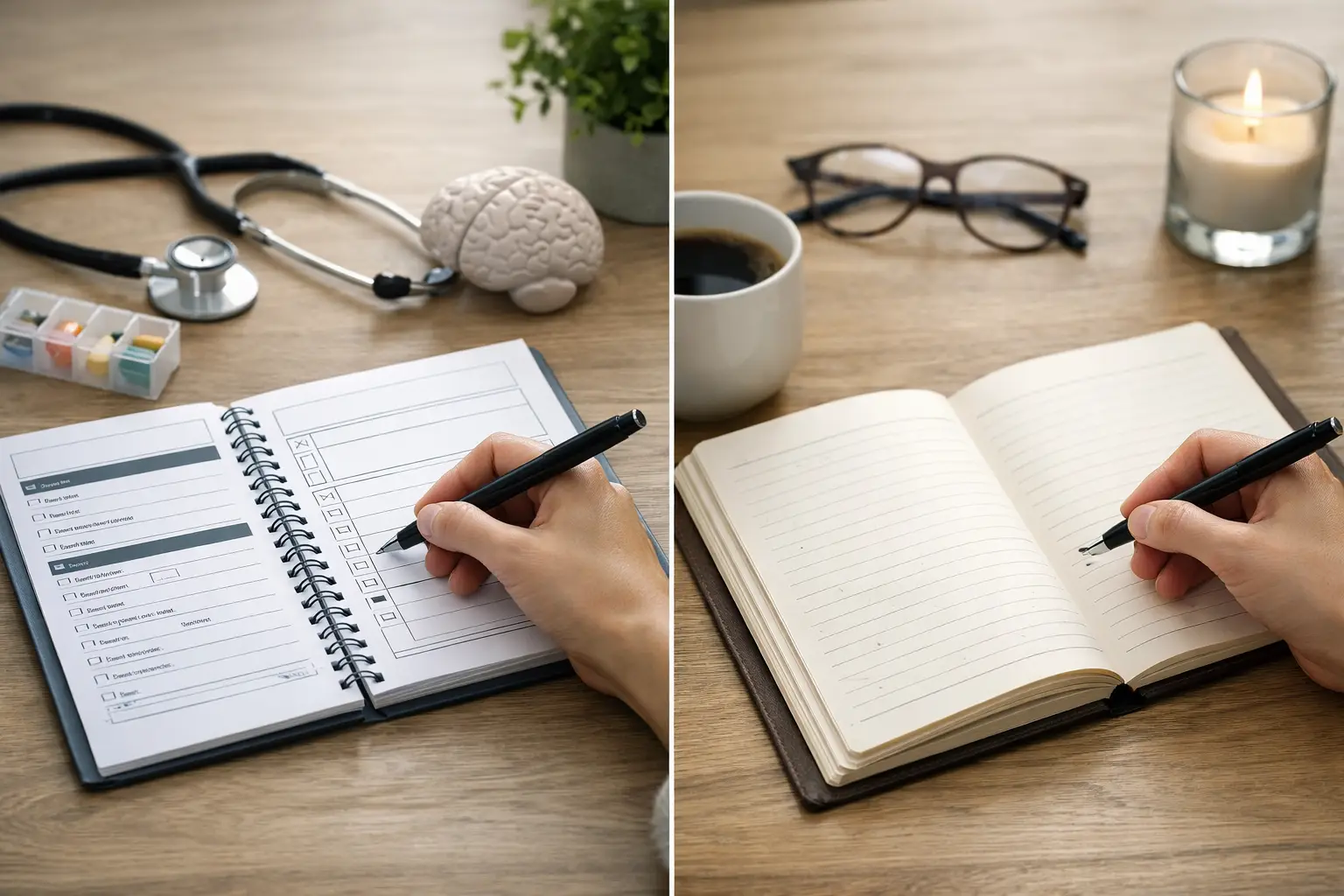
Quick answer: A diary is for processing how FND feels. A symptom journal is for patterns you can take to an appointment. Handwritten journals are easy to start and hard to use when you are exhausted. SeizeControl is FND Connect's private tracking app: log episodes, symptoms and context, then bring a clearer summary into clinic instead of a pile of pages.
Some days, FND leaves very little energy for recording anything. On others, you may need to make sense of symptoms that changed three times before lunch. The question of an FND symptom journal versus diary is not about doing tracking perfectly. It is about noticing patterns, explaining your reality and making appointments a little less overwhelming.
You are not making this up if your symptoms fluctuate, if you cannot remember the detail later, or if writing everything down feels like another demand. A good record should support your life with FND, not take it over. For the health record itself, that usually means a structured tracker rather than a notebook you then have to decode in the waiting room.
FND symptom journal versus diary: what is the difference?
A diary is usually a personal account of your day. You might write about how you felt, what happened at work, a difficult conversation, a good moment with family or the frustration of cancelling plans again. It can hold the emotional side of living with FND, including the things that do not fit neatly into a symptom chart.
A symptom journal is more focused. It records health information in a consistent way: functional seizures or episodes, tremor, weakness, pain, dizziness, speech changes, fatigue, brain fog, sleep, medication changes and possible triggers. The aim is not to prove that you are ill. The aim is to create a clearer picture for you and, if helpful, for the professionals involved in your care.
The main difference is purpose. A diary helps you process. A symptom journal helps you spot and communicate patterns. You can use both. They are not doing the same job.
Why a handwritten symptom journal often fails people with FND
A paper journal is easy to start. The problem is rarely the first page. It is still having a usable record six weeks later, when fatigue, brain fog, a flare or a cancelled appointment has already used up the energy you would need to review it.
Handwritten notes tend to break down in the same ways:
- They are hard to review. Six weeks of pages before neurology is not a summary. Finding the pattern can take more energy than you have in the waiting room.
- They scatter the context. Sleep, heat, medication changes, cycle timing, recovery debt and what you had to cancel often live in different notebooks, phone notes or memory.
- They are easy to lose or leave at home. The appointment still happens. The evidence stays on the kitchen table.
- They become a second job. Long free-writing entries feel thorough on the day and unreadable later. Missing days then feel like failure, so people stop altogether.
None of that means you were doing it wrong. It means the format is asking a lot from a nervous system that is already under load. A useful FND record has to be brief, repeatable and easy to turn into two or three clear points for clinic.
The practical symptom journal is SeizeControl
That is why we built SeizeControl. It is FND Connect's private tracking workspace: the place for the health record, not another diary you have to rewrite by hand.
SeizeControl is designed for people who need more than a blank page. You can log functional seizures, episodes and other FND symptoms in a consistent way, keep medication and recovery context with the same timeline, and review patterns before an appointment instead of reconstructing them from memory.
What that looks like in practice:
- Structured logging for onset, duration, awareness, speech, recovery and what the episode stopped you doing.
- Context in one place — sleep, medication changes, cycle timing, heat, activity and recovery — so you are not flipping between a notebook and a calendar.
- Appointment-ready summaries you can review before GP, neurology, physiotherapy or occupational therapy, rather than handing over every page.
- Private by default. Your record stays yours. Sign in on FND Connect to open it through shared login.
It will not diagnose FND, prove a trigger or replace medical care. No tracker can. What it can do is stop the appointment depending on whether you happened to remember Tuesday.
Private tracking from FND Connect
Use SeizeControl as your symptom journal
Log episodes, symptoms and context in one private workspace, then take a clearer summary into clinic instead of a handwritten pile.
What a useful entry actually contains
The most useful record is brief and repeatable. Rather than trying to capture every sensation, choose the symptoms or events that matter most to you.
If functional seizures are a concern, note when an episode happened, roughly how long it lasted, what you were doing beforehand, how you felt afterwards, whether you were injured and whether anyone witnessed it. If fatigue, weakness or brain fog is the bigger issue, track activity, rest and the effect on the next day.
A simple entry can include:
- the date and roughly when it happened
- your main symptoms, and how much they changed what you could do
- likely context: sleep, heat, travel, medication, a busy sensory day
- what helped, and what you had to change or cancel
That last part matters. "Could not safely cook dinner", "needed help with stairs" or "missed a work meeting" often communicate the impact of FND more clearly than a score out of ten. SeizeControl is built so those details sit on the same timeline, instead of living in the margin of a notebook.
If you cannot use a phone, a few consistent prompts in a notebook are still better than nothing. They are a fallback, not the format we would choose first. For most people, a structured app is less work, not more, because you are not re-reading weeks of handwriting before clinic.
When a diary may still be the kinder choice
A diary can be particularly useful in the early days after diagnosis, when there is a lot to take in and you may be carrying years of being misunderstood. FND can affect confidence, relationships, identity, work and independence. A private space to put words around that experience can be meaningful.
For some people, free writing feels safer than rating symptoms. Numbers can feel too clinical, or can create pressure to decide whether a day was "bad enough". There is no single right scale for a symptom that is variable, invisible or difficult to describe.
A diary can also capture meaning that does not belong in a clinical summary: the relief of being believed, the grief of cancelling again, the joke that got you through the afternoon. That writing is valid. It is just a different job from the record you take to an appointment.
Keep the two apart if you can. Use SeizeControl for what happened. Use a diary, if you want one, for how it felt. Mixing them often makes both harder: the health record becomes too long to scan, and the diary becomes a catalogue of symptoms.
Do not turn tracking into a full-time job
There is a point where monitoring can become unhelpful. If you are checking every feeling, writing for long periods, losing sleep over your notes or becoming more anxious because you are watching for symptoms, scale it back. Tracking should give you information, not keep you in a constant state of alert.
Try recording for a defined period, such as two weeks before an appointment, rather than indefinitely. Or choose a once-a-day check-in. On a difficult day, a single line is enough: "High fatigue, two episodes, rested most of the afternoon." Missing entries does not make your record useless. It means you were living your life, coping with symptoms or simply needed a break.
It can also help to avoid searching for one perfect trigger. FND symptoms can change for many reasons, and sometimes there is no obvious explanation. A pattern is useful when it helps you make a practical choice, such as pacing an activity, planning recovery time, asking for support or raising a concern with your clinician. It is not a test you can fail.
Put pacing into the same picture
Plan the energy cost before the activity
SeizeControl's Energy Planner turns the existing risk forecast into six-hour energy windows, then helps you see what comfortably fits while protecting some capacity for later.
Open the Energy PlannerTake a summary into the appointment, not every page
Before GP, neurology, physiotherapy, occupational therapy or mental health review, you do not need to hand over every entry. Pull out two or three clear themes. You might say: "Episodes have been more frequent after poor sleep," "my recovery time is increasing", or "fatigue is now stopping me from managing shopping safely". Add the questions you want answered and the support you are asking for.
That is often more useful than trying to remember everything in the room. SeizeControl can help you arrive with that timeline already in one place. Pair it with the appointment pack if you want a one-page sheet of history, safety notes and questions to take in on paper.
A one-page clinic note
- Main concern: what changed, and when.
- Pattern: how often episodes or flares happened, and whether that is new.
- Impact: what you could not do safely — cooking, stairs, work, travel, personal care.
- Context: sleep, illness, heat, medication changes, missed doses, cycle changes or a heavy week.
- Ask: what you want reviewed, such as safety planning, medication, pacing, referral or a repeat prescription.
Keep safety separate from symptom tracking
A journal, an app or a perfectly kept timeline is not a substitute for medical assessment. Seek urgent medical advice for new, severe or significantly different symptoms, especially sudden weakness or numbness, a new severe headache, chest pain, difficulty breathing, serious injury, prolonged loss of consciousness or anything that makes you think someone is in immediate danger.
Even when a symptom feels familiar, trust your judgement if something about it is different. You do not have to decide alone whether it is "just FND". Record the details if you can, but get the right help first. SeizeControl should never delay emergency care.
Frequently asked questions
Is a symptom journal better than a diary for FND?
They do different jobs. A diary helps you process the emotional side of FND. A symptom journal is for patterns and appointments. For the health record, a structured tracker is usually more useful than free writing.
Should I keep a handwritten FND symptom journal?
You can, especially if you cannot use a phone. For most people it is extra work that is hard to review later. SeizeControl is the format we built so the record stays brief, consistent and appointment-ready.
What is SeizeControl?
SeizeControl is FND Connect's private tracking app for functional seizures, episodes, symptoms, medication context and appointment-ready summaries. Your record stays yours. It does not diagnose FND or replace medical care.
Do I have to track every symptom every day?
No. Track the few things that would actually change a decision or an appointment conversation. A two-week burst before clinic, or a once-a-day check-in, is enough for many people. Missing days does not make the record useless.
Can a tracker prove what caused my symptoms?
No. A tracker can show correlation — episodes after poor sleep, around heat, after a medication change — but it cannot prove causation. Use the pattern as a conversation aid for your care team, not as a diagnosis.
When should I seek urgent help rather than logging a symptom?
If symptoms are new, sudden, severe or unlike your usual FND pattern, get medical help first. That includes suspected stroke, chest pain, breathing difficulty, serious injury, a first seizure or a seizure pattern that is not normal for you. Log afterwards if you can.
Sources and further reading
- SeizeControl by FND Connect — private tracking for episodes, symptoms and appointment summaries
- FND appointment pack — a one-page sheet for clinic visits
- Functional seizures hub
- FND and functional seizures: a practical UK guide
- FND, periods, perimenopause and seizure tracking
- Sleep and the FND symptom threshold
- Heat, temperature and functional seizures
- Pacing guide: pacing not racing with FND
- NHS Inform: Functional neurological disorder
- Neurosymptoms: Functional dissociative seizures