
Start with a scene that happens every week in the UK.
Someone finally gets an FND diagnosis after months — sometimes years — of scans, A&E trips and “we can’t find anything wrong.” There is relief in the name. Then the quieter question arrives: what happens now?
In one town, the answer includes a clear explanation, FND-informed physiotherapy, a psychology or neuropsychology route if needed, and a plan for flares. In the next town along the same train line, the answer is a discharge letter, a leaflet, and a waiting list that never quite becomes a service. Same condition. Different commissioning boundary. Different life.
That is the FND treatment postcode lottery. Not a slogan. A lived geography of care.
The short version
National guidance and advisory pathways already describe how FND care should work. The scandal is not that nobody has thought about this. It is that many local commissioners — ICBs in England, LHBs in Wales, and equivalent bodies elsewhere — have not translated those recommendations into funded, usable services.
Diagnosis without rehabilitation. A pathway on a slide deck without a clinic to refer into. Two people with the same condition, an hour apart, living completely different health systems. Scroll to the map if you want the picture first; keep reading if you want the why.
This is systems failure, not personal failure
If you have been told “there is nothing local”, that is not proof that your FND is untreatable or that you failed treatment. It is often proof that the service was never commissioned. Our treatment guide covers what can help when care is available. This article is about why so many people never reach it — and what to do while you wait.
The story behind the gap
People with FND already know this in their bones. Families compare notes in WhatsApp groups and realise the difference is not effort, “mindset” or how hard someone has tried to get better. It is geography and commissioning.
One person leaves neurology with a named follow-up plan. Another is told the diagnosis is good news because “it isn’t a progressive disease” — and then left alone with symptoms that still stop work, school, driving and sleep. Carers learn to become case managers. GPs try to refer into services that exist mainly as documents. Emergency departments see the same faces because planned rehabilitation never started.
If that journey feels familiar, you are not imagining it. You are describing a national pattern with local consequences. For many people, the first rupture is not treatment failure — it is the moment after diagnosis when the system goes quiet. Our piece on finding out you have FND names that shock; this one follows what happens next when the pathway is missing.
And once self-doubt creeps in — “maybe I’m not trying hard enough” — the lottery becomes emotional as well as clinical. That spiral has a name in our community. See the “am I faking it?” spiral if you need language for it.
Look at the map
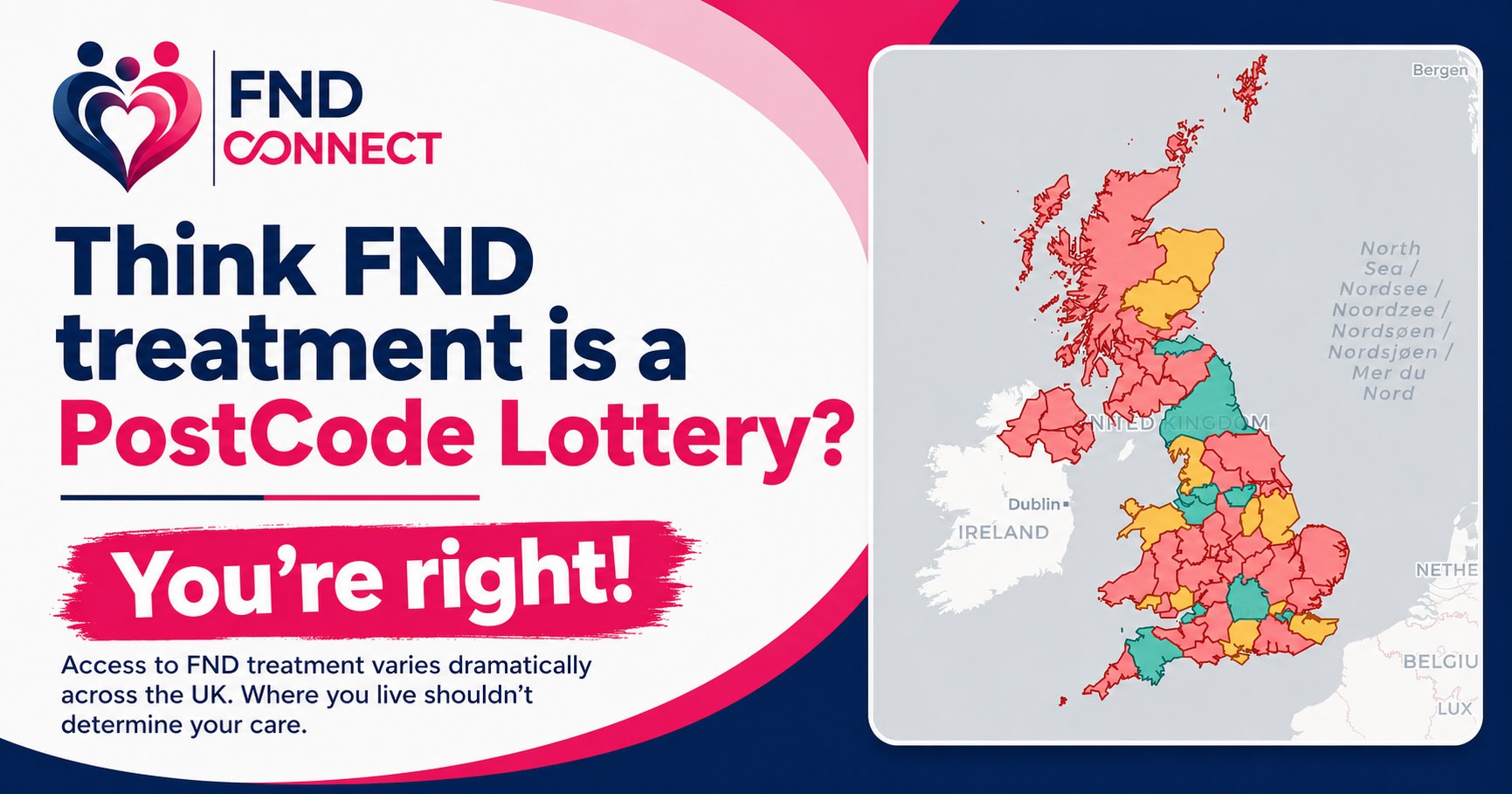
Advocacy without evidence is easy to dismiss. So we built something harder to argue with: a live UK tracker of dedicated FND pathway status by commissioning area. Green means a dedicated pathway has been identified. Amber means something partial or developing. Red means we have not yet identified a dedicated pathway for that area.
Click any area for the status note and evidence. Use it for yourself, for your GP, for your MP, for a local patient group. The point is not shame for individual clinicians. The point is visibility — because invisible gaps stay unfunded.
Maps simplify. A colour cannot capture every excellent clinician working inside a thin service, or every long wait inside a better-resourced area. Local status also changes as teams open, close or rebrand. Still, the overall pattern is hard to defend: where you live should not determine your care.
For the full interactive tables, nation filters and reporting form, open the FND Pathway Tracker. For community experiences mapped differently, see the FND Map.
Open the full tracker
Need the complete UK view, tables and report form?
The pathway tracker is the live public record behind this article — statuses, evidence notes and a way to tell us if your area has changed.
Go to the FND Pathway TrackerNational pathways already exist — on paper
Here is the part that makes people angry once they see it clearly: the UK is not starting from zero knowledge.
Across the country, clinicians, specialty networks and national bodies have spent years describing what a decent FND pathway should include. In plain English, good care usually means:
- timely neurological assessment and a clear, positive explanation of FND;
- investigations only where they are clinically needed;
- access to FND-informed physiotherapy, occupational therapy and speech and language therapy;
- psychological therapy, neuropsychology or neuropsychiatry when those are relevant to the person;
- joined-up multidisciplinary thinking rather than bounce-between-services care;
- a route back into support if symptoms return, change or worsen.
In England, NHS England’s specialised neurology service specification sets minimum expectations for local neurology services, including FND diagnosis and explanation, follow-up where indicated, mental health assessment and treatment, and referral routes into rehabilitation therapies. That is not a fringe wishlist. It is a formal description of what local services should be able to do.
Scotland’s public health information already describes FND treatments as rehabilitation therapies that can retrain function and improve day-to-day life. Wales has discussed national care-pathway proposals after large population research on functional seizures — see our plain-English note on functional seizures research in Wales. Clinical networks and expert groups have published pathway models for years.
So the country knows what good looks like. The insanity is that knowing has not forced local systems to fund it.
Then local commissioners leave the pathway unfunded
Advisory pathways do not book appointments. Local commissioners do.
In England, Integrated Care Boards (ICBs) decide much of what gets prioritised and paid for across their populations. In Wales, Local Health Boards (LHBs) hold that local responsibility. Scotland and Northern Ireland use their own board and trust structures, but the same principle applies: national guidance is not self-executing. Someone still has to create clinic capacity, train the workforce, open the referral route and protect the budget.
What patients report — again and again — is a familiar chain of near-misses:
- the GP is told to refer into “the pathway”;
- the pathway turns out to be a document, a future plan, or a service that only exists in a neighbouring region;
- neurology can diagnose but has no local rehab team to hand on to;
- generic therapy services decline the referral because staff are not FND-trained or the service is not commissioned for this;
- the person is discharged with leaflets, a waiting list measured in years, or both.
That is how you end up with a national conversation about joined-up FND care and a local reality of “we don’t do that here.”
If you are trying to hold that conversation with a clinician who still underestimates FND, our information for GPs and printable appointment pack can help keep the discussion practical rather than combative.
Why a missing pathway hurts more than a long wait
A long wait for a real service is bad enough. A missing pathway is different. It tells people that the system has recognised their condition well enough to name it, but not well enough to treat it as worth investing in.
The human cost shows up quickly:
- Diagnosis without a plan leaves people stuck between “it is FND” and “so now what?”
- Crisis-loop care pushes people back to A&E, repeated scans and emergency admissions because planned rehabilitation never starts.
- Work, education and family life erode while symptoms remain untreated and unexplained to employers or schools — see work adjustments with FND.
- Stigma hardens when the only visible pathway is disbelief, self-management slogans or private care only some can buy.
- Carers absorb the gap — unpaid, exhausted and often invisible to the commissioning conversation. If that is your household, our Carer’s Allowance guide may help with the practical side.
None of this is abstract. It is why two households on different sides of a commissioning boundary can live completely different versions of the same diagnosis. And it is why “you can recover” can land as hope in one clinic and pressure in another — a tension we unpack in hope or pressure around recovery.
A pathway on paper is not a service on the ground
Health systems love pathway language because it sounds like progress. Sometimes it is. Often it is only the first half of the job.
A real pathway needs more than a flowchart:
- Named local ownership — someone responsible for making the route work.
- Funded capacity — clinic slots, therapy time and admin support, not goodwill alone.
- Trained staff — FND-informed clinicians, not a generic list that quietly refuses referrals.
- Clear entry criteria — so GPs and neurologists know how to get people in.
- A safety net — what happens during flares, after discharge, or if symptoms change. Start with our flare or medical emergency guide.
- Equity monitoring — so commissioners can see whether access is still a lottery inside their own patch.
Without those, “we have a pathway” is marketing language for “we have a PDF.”
What good local commissioning looks like
Where FND care works better, it usually shares a few features:
- neurology can diagnose and explain without abandoning the person at the clinic door;
- therapy teams understand functional symptoms as real and treatable;
- psychology or neuropsychiatry is available without implying that FND is “all in the mind”;
- there is a practical route for functional seizures, movement symptoms, speech changes, pain and cognitive load;
- primary care has somewhere useful to send people after diagnosis;
- peer support and charity help sit beside NHS care rather than replacing it.
That combination is not luxury medicine. It is the minimum a serious pathway should deliver. National documents already gesture toward it. Local funding is what turns the gesture into appointments.
If functional seizures are part of your picture, our guide to FND and functional seizures covers safety, aftermath and how to explain events to others. For energy and daily load while you wait, the pacing guide is a practical companion.
What you can do if services are missing where you live
You should not have to campaign for basic healthcare. While the system catches up, practical steps still matter — and they work better when you are not doing them alone.
- Ask the direct commissioning question. “Is there a commissioned FND pathway in this ICB / health board, and if not, who owns that gap?”
- Request specific therapy routes rather than a vague “is there any help?” — FND-informed physio, OT, SLT, psychology, neuropsychiatry.
- Get the answer in writing if the service does not exist. A clear “not commissioned” reply is useful evidence for complaints, MPs and local patient groups.
- Ask about out-of-area options when the local pathway is empty. Some people can be referred further afield even when home services are thin.
- Build a paper trail and a plan for the weeks between appointments — our next-steps pathway is designed for exactly that foggy middle.
- Share the map and this article with GPs, neurology secretaries, councillors and MPs. The postcode lottery is easier to deny when nobody has a picture of it.
- Email your MP using the toolkit below — a ready-made letter with links to this article and the live pathway tracker.
Tools while you wait
Practical FND Connect tools that help hold the story together
These will not replace a funded pathway. They can reduce chaos while you push for one.
- Next-steps plan — build a clear plan after diagnosis or discharge.
- Appointment pack — prepare questions and history for GP or neurology visits.
- SeizeControl — track episodes, patterns and energy load.
- Clinician directory — find FND-aware professionals already listed with us.
- Local support groups — peer connection near you.
- Support hub — urgent help, resources and where to go next.
When statutory routes lag
Practical support and the Fund the FND Gap campaign
If you need mobility aids, communication tools or specialist help the system will not fund promptly, FND Connect’s grant routes exist as a bridge — not a replacement for NHS commissioning. Charity funding should not be this necessary this often.
Read Fund the FND Gap · Apply for support · See recent impact stories
Send this email to your MP
If local services are missing, your MP can still force a written answer from commissioners. Use the toolkit below: enter any UK postcode (England, Scotland, Wales or Northern Ireland) to find your Westminster MP, then copy the email address, subject and body. The draft is strong on purpose — this is not a polite suggestion. It is a demand for funded care.
It links this investigation and the live pathway tracker tables and map so the postcode lottery is evidence, not opinion.
Constituent action
Find your MP and send the letter
Works with postcodes across England, Scotland, Wales and Northern Ireland. We find your current Westminster MP and their public parliamentary email, then draft a strong letter about FND care in your area. Then copy each field into your email app — or open a ready-made message.
Add your full postal address under your name before sending — MPs need to confirm you are a constituent. Covers every UK nation via your Westminster MP (House of Commons). Letter wording adapts for ICBs, health boards and HSC trusts. Data from the UK Parliament Members API and postcodes.io. For MSPs / Members of the Senedd / MLAs, use your national parliament’s own lookup as well.
What commissioners should do now
If you sit inside an ICB, LHB or equivalent body, the ask is simple:
- stop treating advisory FND pathways as optional literature;
- publish whether a local pathway exists, who leads it and how people are referred;
- fund the rehabilitation and mental-health capacity the pathway depends on;
- measure waits, refusals and out-of-area referrals as failure signals, not trivia;
- involve people with FND and carers in service design instead of designing around them.
Every year spent on another working group while clinics remain unfunded is another year of preventable disability, family strain and emergency-care waste. For the public account of what FND Connect is already trying to bridge, see our impact page.
Keep reading — related guides and stories
The postcode lottery sits inside a wider FND life. These pieces sit beside this investigation:

Finding out I had FND
The shock, relief and silence after the diagnosis — and what helps in the first weeks.

Functional seizures guide
Safety, aftermath and how to explain events that look like epilepsy but are not.

The “am I faking it?” spiral
When missing care and disbelief start rewriting how you see yourself.

Hope or pressure?
How to hold hope without turning recovery into another test you can fail.

Work adjustments with FND
Practical language for employers when symptoms and services are both unpredictable.
Using mobility aids part-time
When aids are a bridge, not a failure — especially while therapy access is thin.
Frequently asked questions
Is FND treatment really a postcode lottery in the UK?
Yes. National guidance and advisory pathways describe what good FND care should include, but local commissioning by ICBs, health boards and equivalent bodies varies sharply. In some areas people can reach specialist rehabilitation; in others the pathway exists mainly on paper or not at all. Our live pathway map makes that variation visible.
What is an advisory pathway if services are still missing?
An advisory or recommended pathway sets out how care should be organised: diagnosis, clear explanation, rehabilitation, psychology or neuropsychology where needed, and a route back into support. It is not the same as a funded clinic. Without local set-up and money, the pathway does not become care people can actually use.
Who decides whether an FND pathway is funded locally?
In England, Integrated Care Boards (ICBs) commission most local NHS services. In Wales, Local Health Boards (LHBs) do. Scotland and Northern Ireland use their own health-board and trust structures. National specifications and clinical advice matter, but local commissioners still decide what is prioritised and funded on the ground.
What should I do if I have an FND diagnosis but no treatment plan?
Ask your GP or neurologist which FND-informed physiotherapy, occupational therapy, speech therapy, psychology or neuropsychiatry routes exist locally, whether there is a named pathway, and how to be referred. Keep a short written record of symptoms, impact and what has already been tried. Use our next-steps tool and appointment pack. If local services are thin, ask about out-of-area referral options and support while you wait.
Does a postcode lottery mean FND is not treatable?
No. Uneven access is a systems failure, not proof that treatment is pointless. Many people benefit from clear explanation and FND-informed rehabilitation when they can get it. The problem is that the recommended care is available in some places and missing in others. Read more in our treatment guide.
How can I help improve FND services in my area?
Share this article and the pathway tracker with your GP practice, neurology team, local Healthwatch, councillor or MP. Ask in writing whether a commissioned pathway exists. Report local updates through the tracker. Join or start a support group, and consider sharing your experience on our stories page so commissioners hear real voices, not only service lists.
Sources and further reading
This article is general advocacy and information, not individual medical advice. Local service availability changes; always confirm the current pathway with your GP, neurology team or health board.
- NHS England specialised neurology service specification (August 2025) — minimum local neurology services, including FND.
- NHS Inform: Functional neurological disorder — public information on FND and rehabilitation approaches.
- FND Connect treatment guide — plain-English overview of what can help when care is available.
- FND Pathway Tracker — live map of dedicated pathway status across ICBs, health boards and trusts.
- FND Map — community experiences made visible across the UK.
- Functional seizures in Wales research — population research and pathway implications.
- Fund the FND Gap — FND Connect’s campaign for practical support when statutory routes fall short.
- Start here — the simplest entry point if you are new to FND Connect.