
About this item
FND Connect Vocal Tics Disability Card
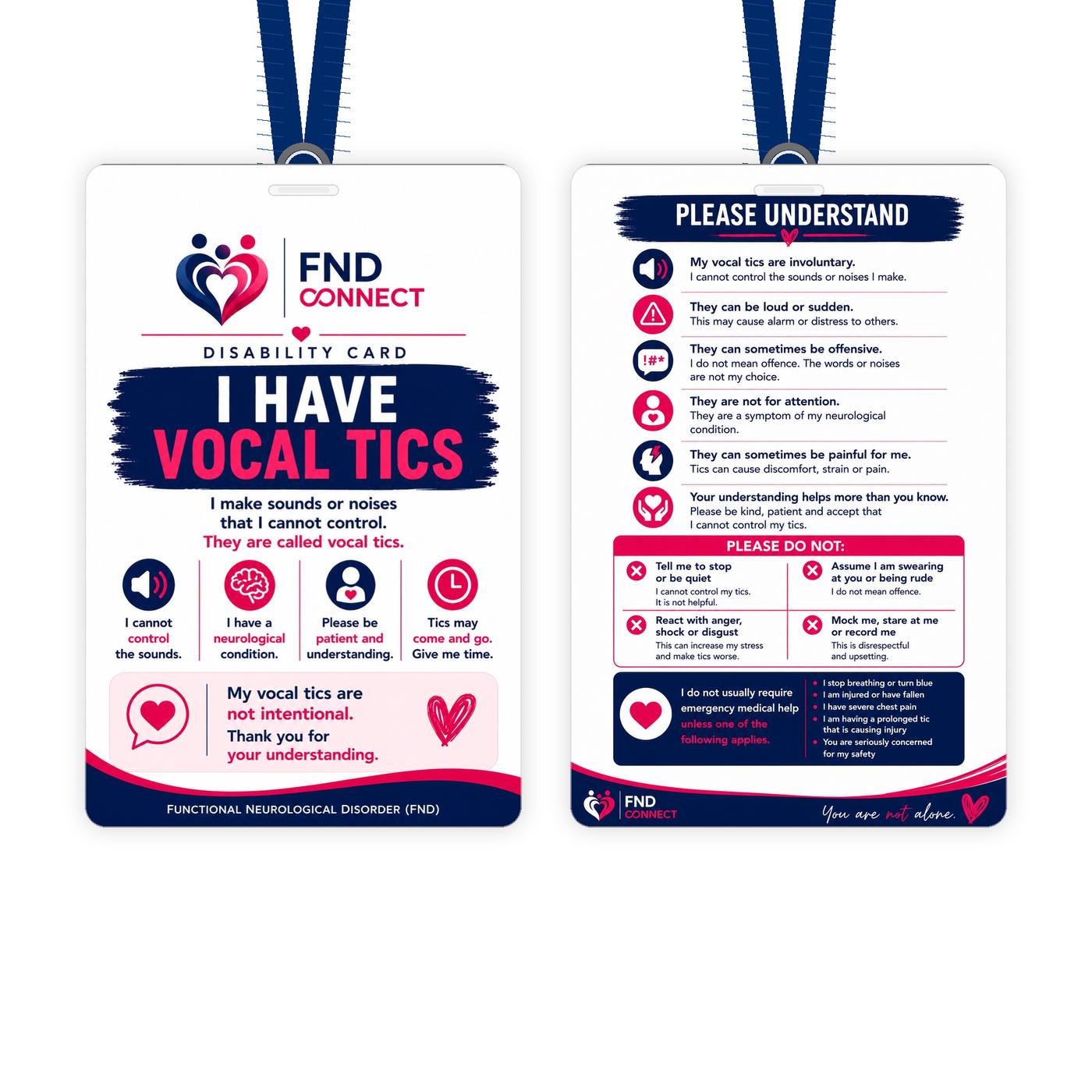
The FND Connect Vocal Tics Disability Card is designed to help people understand what is happening when someone experiences vocal tics caused by a neurological condition such as Functional Neurological Disorder.
Vocal tics can involve sounds, noises, words, phrases, or sudden vocal outbursts that the person cannot control. They may be loud, unexpected, repetitive, distressing, or sometimes misunderstood by people nearby.
For some people, vocal tics may occasionally sound offensive, alarming or inappropriate. This can be incredibly upsetting for the person experiencing them, especially when others assume they are being rude, attention seeking, disruptive, or choosing to behave that way.
This card helps explain clearly and calmly that the vocal tics are involuntary, not intentional, and not within the person’s control.
The front of the card gives a clear message for others:
- I have vocal tics
- I make sounds or noises that I cannot control
- They are called vocal tics
- I cannot control the sounds
- I have a neurological condition
- Please be patient and understanding
- Tics may come and go, so please give me time
- My vocal tics are not intentional
The reverse side explains that vocal tics are involuntary and may be loud, sudden, alarming, distressing, or sometimes offensive. It makes clear that the person does not mean offence, the words or noises are not their choice, and the tics are not for attention.
It also explains that vocal tics can sometimes be painful or uncomfortable for the person experiencing them, causing strain, distress or physical discomfort.
The card includes a clear “please do not” section, helping others understand not to tell the person to stop, assume they are being rude, react with anger or disgust, mock them, stare at them, or record them.
It also includes emergency guidance, explaining that the person does not usually require emergency medical help unless there are serious concerns such as breathing problems, injury, severe chest pain, a prolonged tic causing injury, or serious concern for their safety.
There is space to write the cardholder’s name and emergency contact details, making it useful for daily life, public spaces, shops, schools, work, travel, appointments, events, public transport and situations where the person may not be able to explain their vocal tics in the moment.
Key features
- Double-sided FND vocal tics awareness card
- Explains that vocal tics are involuntary and not intentional
- Helps reduce misunderstanding, judgement and inappropriate reactions
- Clear guidance for members of the public, staff, carers, friends and family
- Explains that vocal tics may be loud, sudden, distressing or sometimes offensive
- Makes clear that the person does not mean offence
- Includes clear “please do not” guidance
- Includes emergency warning signs
- Space for name and emergency contact
- Designed in FND Connect colours
- Suitable for use with a lanyard or card holder
This card is not a medical alert device and does not replace medical advice, diagnosis or emergency care. It is designed as a communication and awareness aid to help others respond calmly, kindly and appropriately when someone is experiencing vocal tics.